Exam Tactics and Trade-off Drills
You have the method and two full rehearsals. This final lesson is about the exam room itself: how AI-architecture questions are built, which trade-off tables to have memorized, and the habits that separate passing answers from failing ones.
How the questions are structured
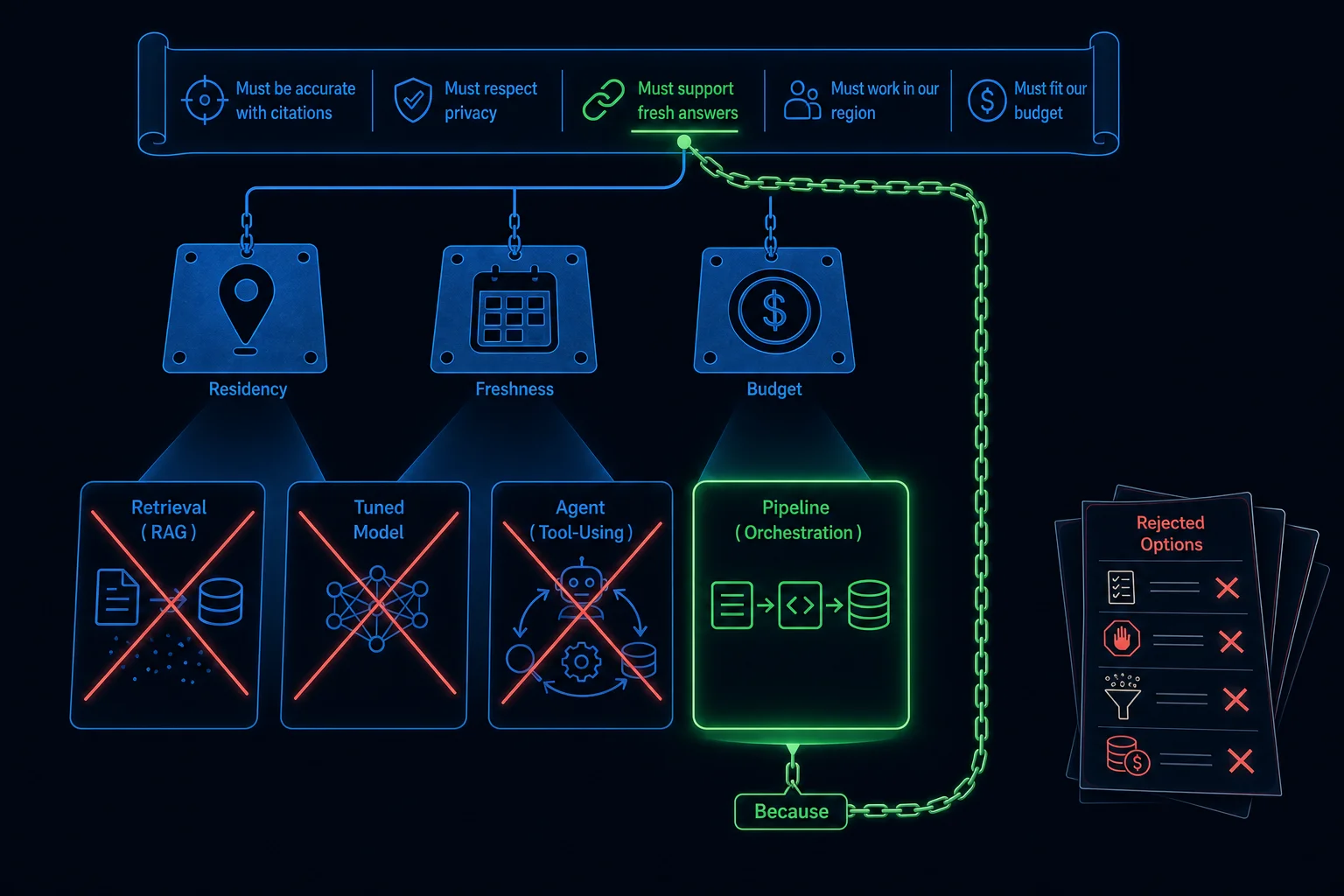
Nearly every design question follows one shape: scenario → constraints → "what do you recommend and why?" The scenario sets the domain (an agency, a hospital, a bank); the constraints are the real question — data residency, budget, freshness, a compliance regime, an SLA. Read the constraints twice: each one usually eliminates an option, and examiners choose them so that exactly one pattern survives. If two options still look viable, you missed a constraint. Then answer in the method's order — requirements, data, pattern, guardrails, operations — so the grader can follow your reasoning even where they would have chosen differently.
The trade-off tables worth memorizing
Four comparisons cover most questions. Know each side's one-line strength and cost:
- RAG vs fine-tune — RAG: fresh, citable, controllable knowledge; costs retrieval latency and index ops. Fine-tune: style, format, and latency; frozen knowledge, no citations, retrain to update. Facts → RAG; behavior → fine-tune.
- Local vs cloud models — local: data residency, per-call cost ~zero, offline; weaker ceilings and you own the ops. Cloud: frontier capability, elastic; per-token cost, egress, dependency. The hybrid answer — local embeddings, cloud generation, as this platform runs — is often the strongest recommendation when you justify the split.
- Agent vs pipeline — a fixed pipeline is deterministic, testable, cheap; an agent handles open-ended tasks but multiplies failure modes and cost. Default to the pipeline; earn the agent.
- Vector vs hybrid vs lexical retrieval — vector finds meaning but misses exact identifiers; lexical (BM25) nails form numbers and error codes but misses paraphrase; hybrid buys both for extra infrastructure. IDs and citations in play → say hybrid.
Red flags that fail candidates
Graders pattern-match failures fast. Never submit an answer with: no evaluation plan (no golden set, no metric, no pre-release gate); no failure handling (what happens when retrieval is empty, the model hallucinates, the API is down — if you never say refuse, fail closed, or escalate to a human, you fail the governance dimension); LLM-for-everything (proposing a model where a SQL query, a rules engine, or classical ML is cheaper and deterministic — spotting where not to use AI is scored as architecture maturity); and ignoring cost at volume.
The closing habit: every recommendation gets a "because"
Never end a sentence at the technology. "Use RAG" earns nothing; "use RAG because the fee schedules change weekly and answers must cite the official page" earns the marks — the because ties the choice to a requirement, which is the entire job. Drill it until it is a reflex, in writing and out loud. An architect is someone whose every decision can be traced back to a requirement; show that on every line, and you are ready.