The Adaptation Spectrum
"How do I make the model do what my organisation needs?" is the most common question an AI architect gets asked — in design reviews and in interviews. The answer is a spectrum of adaptation techniques, ordered from cheapest and most reversible to most expensive and most invasive. The core distinction to hold onto: the first three techniques change what goes into the context window at request time; the last two change the model's weights. Context is cheap, instant, and undoable. Weights are expensive, slow, and sticky.
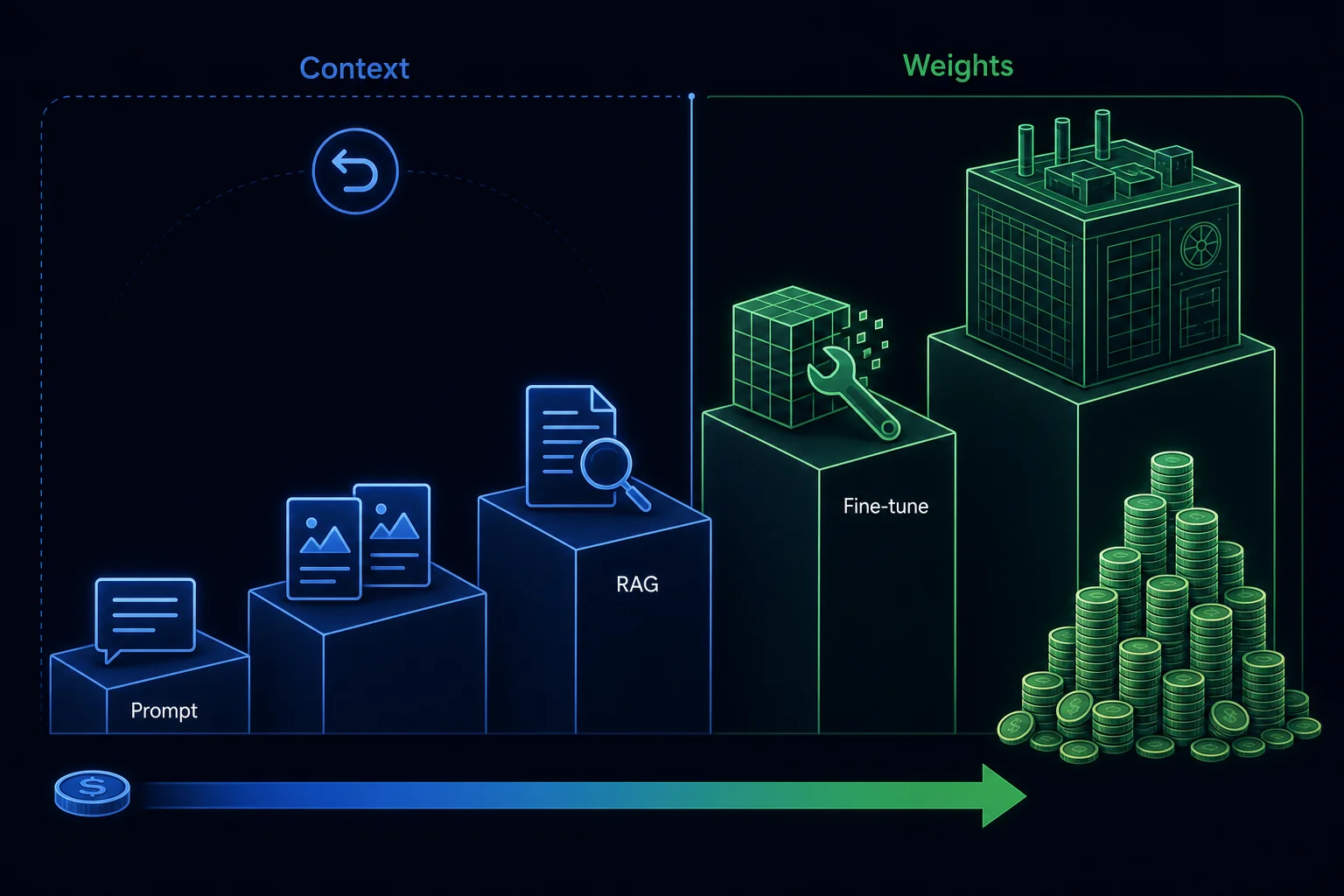
The five rungs
- System prompt. Instructions prepended to every request — persona, rules, output format. Changes nothing but text; deployable in minutes; costs a few hundred tokens per call. Always start here. The LyraLearn Tutor's grounding rules are pure system prompt.
- Few-shot examples. Worked input/output pairs placed in the prompt so the model imitates the pattern. Still just context, but it steers format and edge-case handling far better than instructions alone. Cost: more tokens per request.
- RAG. Retrieve relevant documents at query time and ground the answer in them (Module 6). This is how you add knowledge the model was never trained on, with citations and instant updates. Cost: an ingestion pipeline, a vector store, and retrieval latency per request.
- Fine-tuning. Continue training an existing model on hundreds-to-thousands of your own examples, adjusting its weights so the desired behaviour becomes default. Cost: curated training data, GPU time or a hosted tuning job (Azure OpenAI offers this as a service), a separate model deployment to host, and re-evaluation on every base-model upgrade.
- Training from scratch. Pre-training a new model on trillions of tokens. Costs run to millions of dollars and a research team. For an enterprise architect this is almost never the answer — it exists on the spectrum so you can explain why you're not doing it.
Context vs weights — the exam framing
Everything on rungs 1–3 is in-context learning: the base model is untouched, so changes ship with a config deploy, roll back with one, and every request can behave differently. Rungs 4–5 are parametric: the knowledge or behaviour is baked into weights, shared by every request, and changeable only by training again.
Climb only as far as you must
The architect's rule is to exhaust each rung before paying for the next. A surprising share of "we need fine-tuning" requirements dissolve under a better system prompt plus five good few-shot examples — at one-thousandth of the cost. The next lesson looks at what fine-tuning actually involves when you genuinely do need rung 4; lesson three turns the spectrum into the decision framework interviewers expect you to recite.