What Is AI Architecture?
AI Architecture is the discipline of designing systems that use artificial intelligence reliably, safely, and economically inside a real organization. It is much less about training models and much more about everything around the model: where data comes from, how the model is invoked, how outputs are validated, how the system fails, and how the whole thing is operated and governed over time.
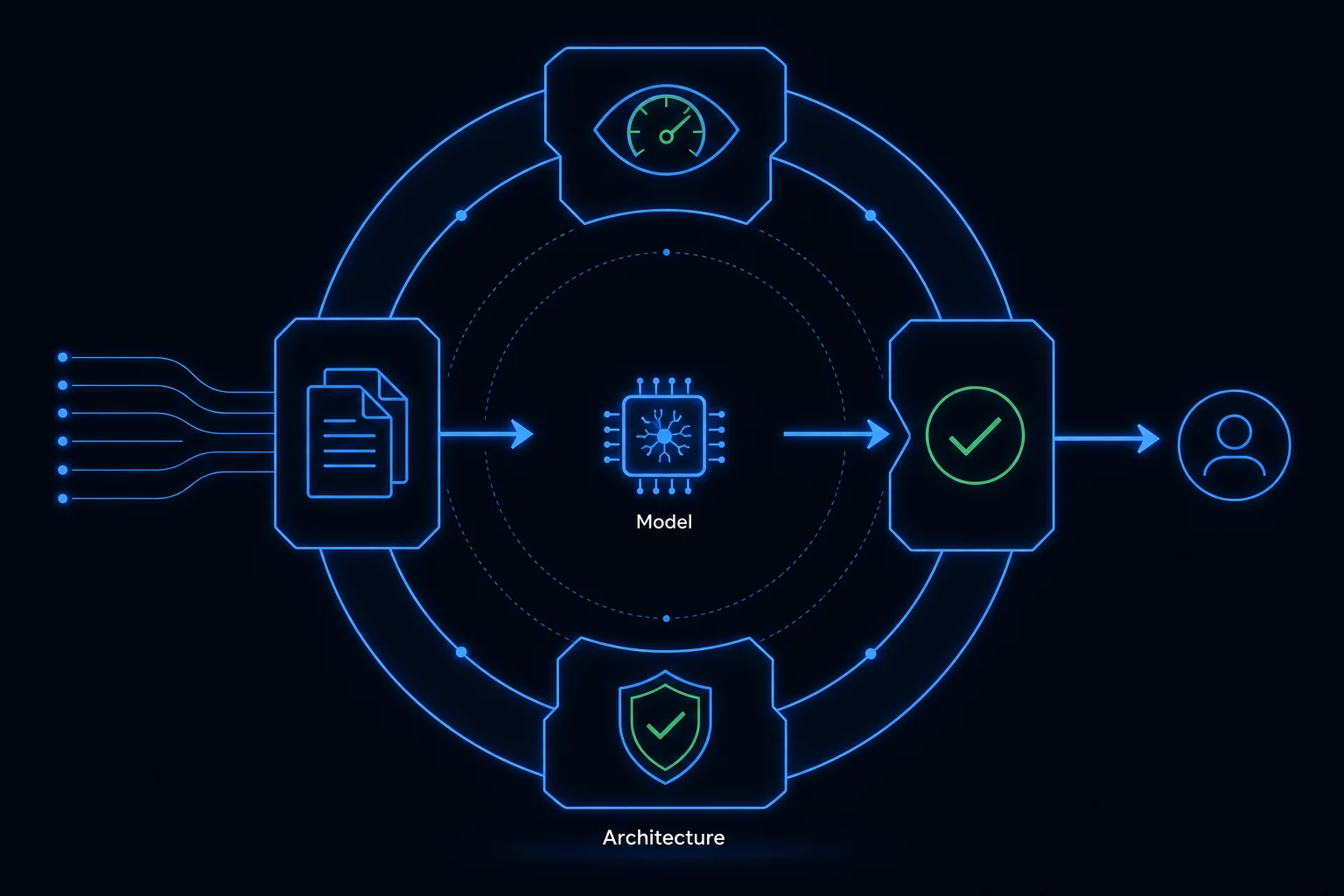
The architect's job
A software architect answers "how do these components fit together so the system meets its quality goals?" An AI architect answers the same question for systems whose behavior is probabilistic rather than deterministic. That single difference — the model can be wrong, and confidently so — reshapes every design decision:
- Grounding over recall. Instead of trusting a model's memory, you retrieve facts and make the model answer from them (see Module 6, RAG).
- Validation over trust. Model output is treated as a proposal to be checked, not a result to be used directly.
- Fail-closed over fail-open. When the system is unsure, it refuses or escalates rather than guessing.
What an AI architect actually designs
In an enterprise (.NET / Azure / SQL Server, say), the AI architect owns decisions like:
- Data flow — what content the AI can see, and how it gets there safely.
- The inference path — which model runs where (local vs cloud), and why.
- Guardrails — prompt-injection defense, output validation, human escalation.
- Observability — logging every AI call so behavior can be measured and improved.
- Governance — model versioning, audit, and policy a public-sector reviewer would accept.
Why it matters
Most failed AI projects don't fail because the model was bad. They fail because the architecture around the model was missing: no grounding, so it hallucinated; no validation, so a bad answer reached a user; no observability, so nobody noticed. The rest of this course builds each of those pieces, on a real stack, one module at a time.