The ML Landscape
Before LLMs, "AI in production" almost always meant machine learning: algorithms that learn a function from data instead of being explicitly programmed. Exams (AI-900 especially) and architect interviews still test this vocabulary hard, because most enterprise AI workloads — fraud flags, demand forecasts, document routing — are classical ML problems, not chat problems.
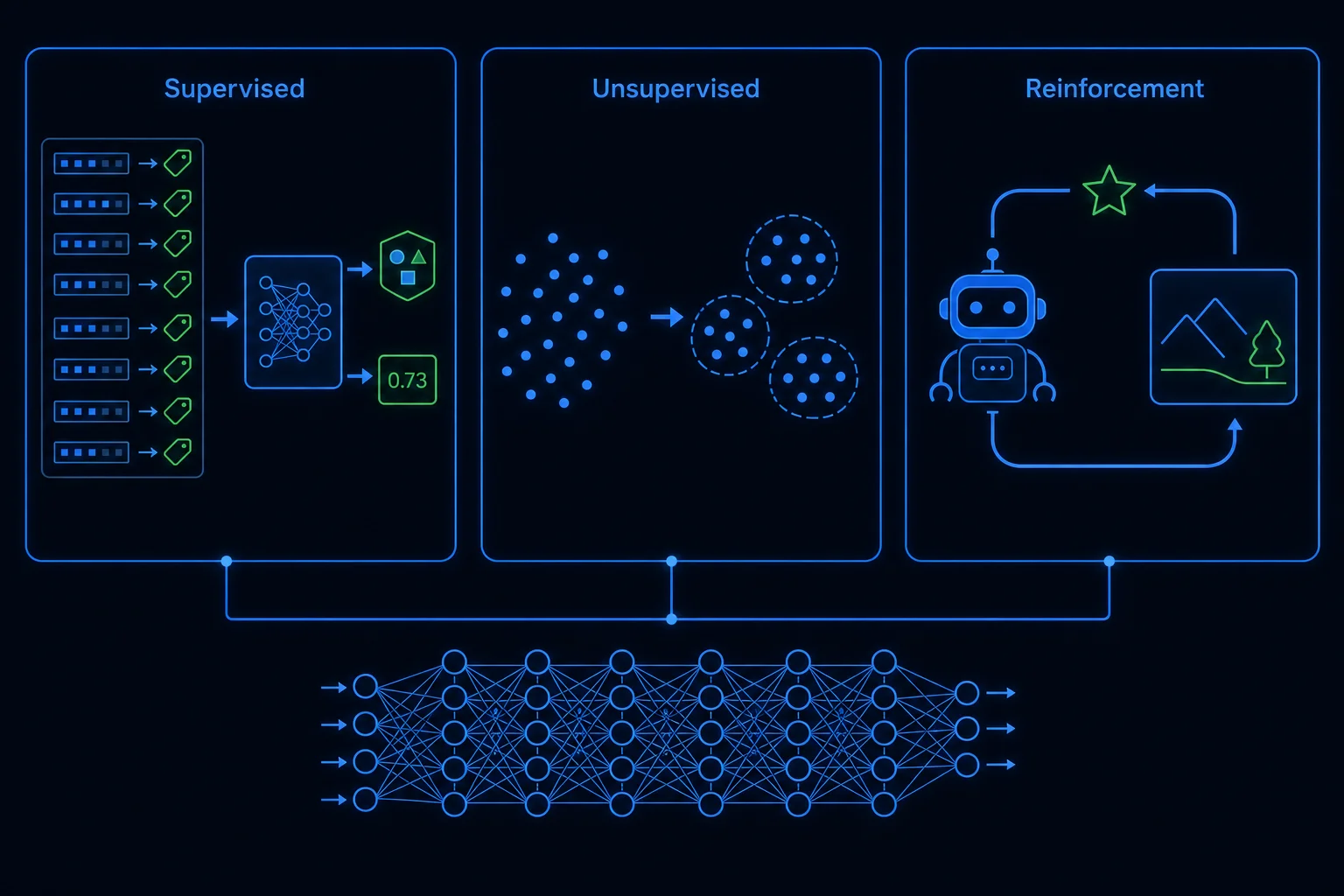
The three learning paradigms
- Supervised learning — you have historical examples with known answers. Each example is a set of features (the inputs: claim amount, claimant age, days since last claim) and a label (the known outcome: fraudulent or not). The model learns to map features to labels. This is the workhorse of enterprise ML.
- Unsupervised learning — you have data but no labels. The algorithm finds structure on its own: grouping similar citizens' service requests, spotting unusual network traffic (anomaly detection). Useful when labeling is expensive or the categories aren't known up front.
- Reinforcement learning — an agent learns by trial and reward in an environment (game playing, robotics, resource scheduling). Rare in line-of-business systems, but exams expect you to recognize it — and it's how LLMs get their final alignment polish (RLHF).
The three core task types
Exam questions love "which task type is this?" Map them by the shape of the output:
- Classification — predict a category: spam/not-spam, approve/deny/refer, which of 12 departments should handle this ticket. Output is a discrete class (binary or multiclass).
- Regression — predict a number: next quarter's call volume, a property valuation, time-to-resolution in hours. Output is continuous.
- Clustering — group similar items with no predefined categories. Unsupervised by definition: you don't tell it the groups; it finds them.
Quick test: "will this customer churn?" is classification; "how much will they spend?" is regression; "what natural segments exist in our customers?" is clustering.
Where deep learning and LLMs fit
Deep learning is not a fourth paradigm — it's a family of models (neural networks with many layers) used within those paradigms, dominant wherever the input is unstructured: images, audio, free text. Large language models are deep learning taken to an extreme: transformers trained with self-supervision on huge text corpora, then fine-tuned. They are still probabilistic predictors — the landscape from Module 1 applies unchanged.
The architect's takeaway: LLMs did not replace this landscape; they sit inside it. A tabular fraud model is still a supervised classifier, and — as the next lessons show — often the cheaper, faster, more explainable choice. LyraLearn itself pairs both: classical retrieval ranking feeds a generative model, each doing the job it's structurally suited for.