Presenting Your Work
A blueprint nobody can read is worth nothing. The final step of the capstone is packaging — turning your design into a portfolio artifact and an interview narrative that demonstrate AI-architect judgment, not just that you can call an API. The goal is for a reviewer to finish your materials and think "this person can be trusted to own AI systems in production."
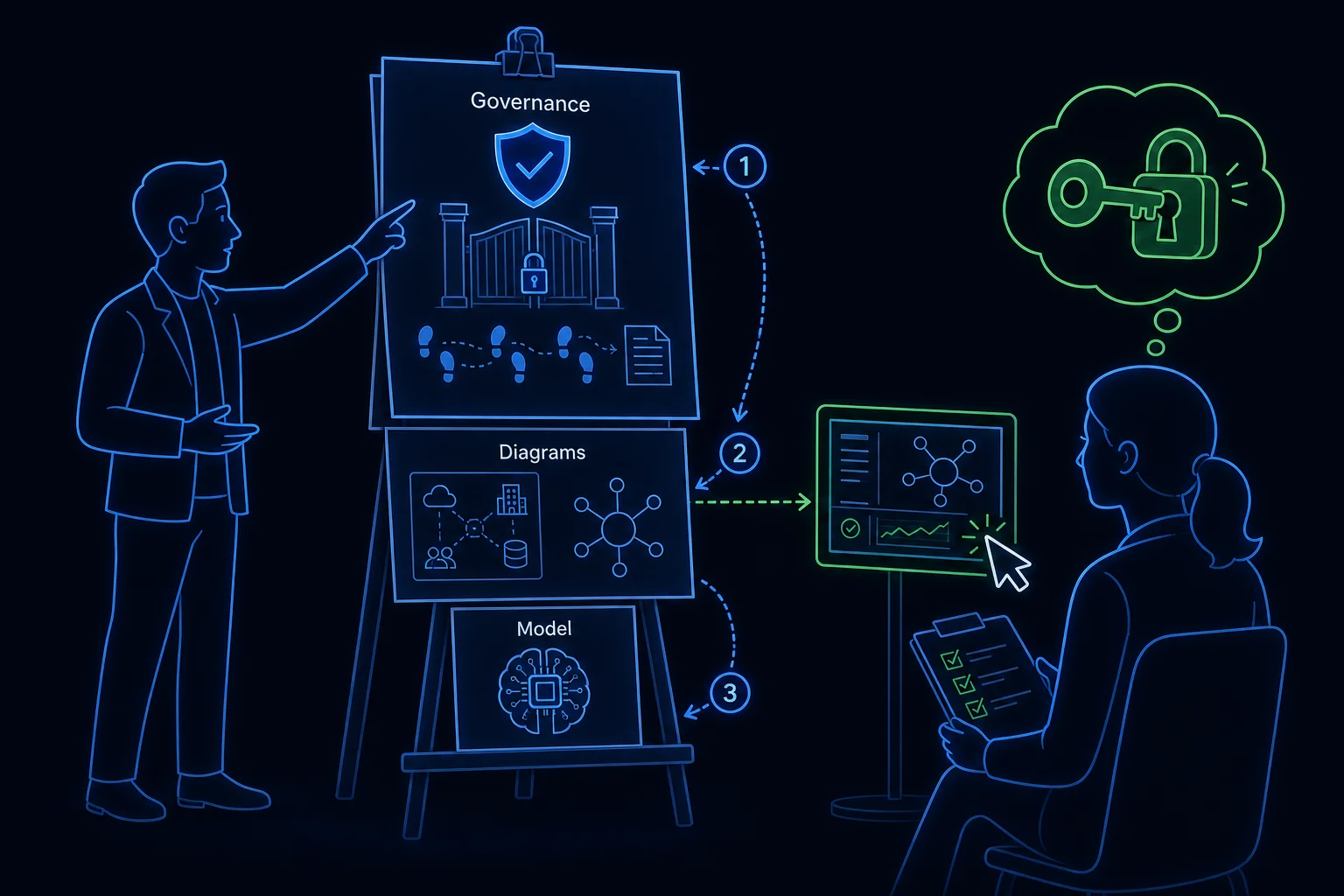
Assemble the architecture documents
Pull your work into a tight, professional set of artifacts. Reuse the doc types from Module 16's Repo Init Platform — the same discipline applies to your own portfolio:
- An overview — the problem, the five solutions, and the one-core thesis in a page.
- Diagrams — a context diagram, the shared-core pipeline, and one data-flow per solution.
- A security & governance mapping — for each solution, name the grounding source, the output validation, the fail-closed / escalation path, and what gets audit-logged.
- An operations view — observability, runbooks, and human-in-the-loop touchpoints.
Keep it skimmable: bold the decisions, use lists, and let the diagrams carry the structure. A reviewer should grasp the shape in two minutes and find the depth when they look for it.
Lead with governance, not the model
The instinct is to talk about prompts and embeddings. Resist it. Public-sector and enterprise reviewers care most about the questions that keep AI out of trouble:
- Where does the content come from, and is it approved?
- What stops a hallucinated answer from reaching a user?
- When the system is unsure, does it refuse and escalate — fail-closed?
- Can you reconstruct what the AI did, from the logs, after the fact?
Answering these clearly is what separates an architect from a coder. Show the security/governance mapping first; the clever retrieval is supporting detail.
Build the interview narrative
Have a crisp story ready to tell out loud:
- The problem — one organization, five real AI needs.
- The insight — they're the same system; build one reusable RAG core, reuse it five ways.
- The proof — LyraLearn and the live
ctc.lyracreation.comdemo make it real and clickable. - The judgment — citations, fail-closed escalation, observability, and audit are designed in, not bolted on.
What you're demonstrating
Walking through that narrative, you are showing AI-architect judgment: the ability to see reuse across surface differences, to design for reliability and governance before features, and to make trade-offs a reviewer can audit. That — far more than any single chatbot — is the capstone, and the thing that earns the title AI Architect.