Working with LLMs Reliably
A probabilistic component can still be part of a reliable system — if you constrain it. This lesson covers the practical controls that turn an unpredictable model into a dependable building block.
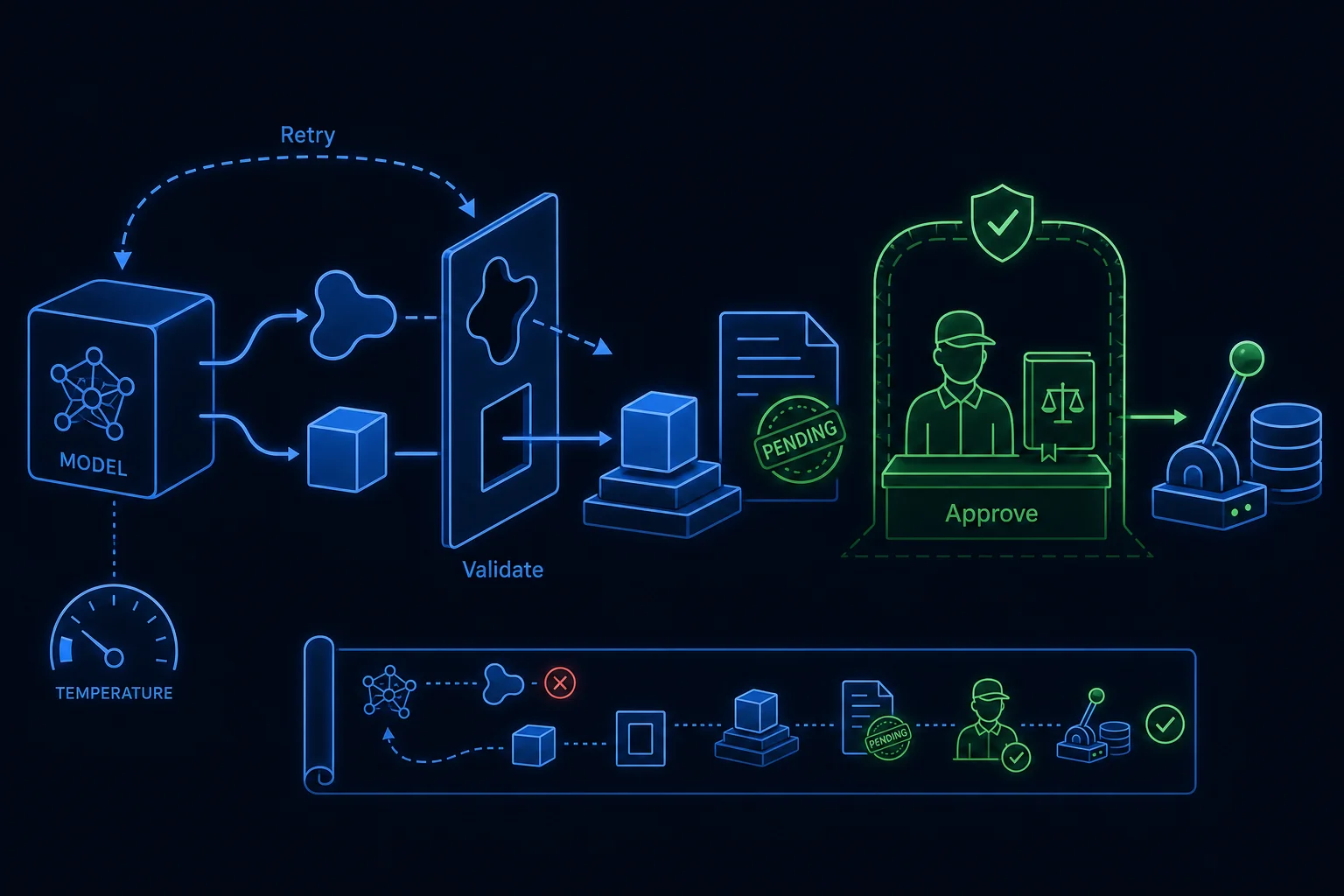
Control randomness with temperature
Temperature governs how much the model "explores" when sampling the next token. Low temperature (≈0–0.3) makes output focused and more repeatable; high temperature makes it more varied and creative. For most enterprise tasks — extraction, grounded Q&A, classification — you want low temperature for consistency. Save higher temperature for genuinely creative work.
Force structure where you can
Free-form text is hard to validate; structured output is not. When the task has a shape (fields to extract, a quiz to generate, findings from a review), require the model to return JSON matching a schema. Then:
- Invalid output is rejected and retried, never stored.
- Downstream code can rely on the shape instead of parsing prose.
- A hijacked or confused generation can't write garbage into your system.
This single technique removes a whole class of failures.
Make outputs proposals, not actions
Never wire a model's raw output directly into a sink that does something — a shell command, a SQL string, an HTML page, an email send. Treat output as a proposal that code validates, escapes, or a human approves before it has any effect. (LyraLearn's AI features only ever produce text and structured findings — they never execute anything.)
Plan for failure explicitly
The provider will sometimes be slow, rate-limited, or down. Reliable design means:
- Timeouts on every call, so a hung provider doesn't hang your app.
- Fail closed — on outage or low confidence, refuse or escalate rather than degrade to a guess.
- Idempotency — a retried call shouldn't double-charge or duplicate work.
Measure everything
Because errors are silent, you cannot improve what you don't observe. Log every call: provider, model, tokens, latency, and whether the system refused. That record is both your operational dashboard and the dataset you use to make the AI better over time.
Put together — low temperature, structured output, output-as-proposal, fail-closed, and full observability — these are the controls that let a probabilistic model live safely inside a production system.