Reliability in Agents
An agent hands control flow to a probabilistic model, which multiplies every risk you learned to manage for a single call. A bad generation no longer just returns bad text — it can loop forever, take a wrong action, and then take another based on that one. Reliability comes from bounding what the agent can do and verifying what it did at every step.
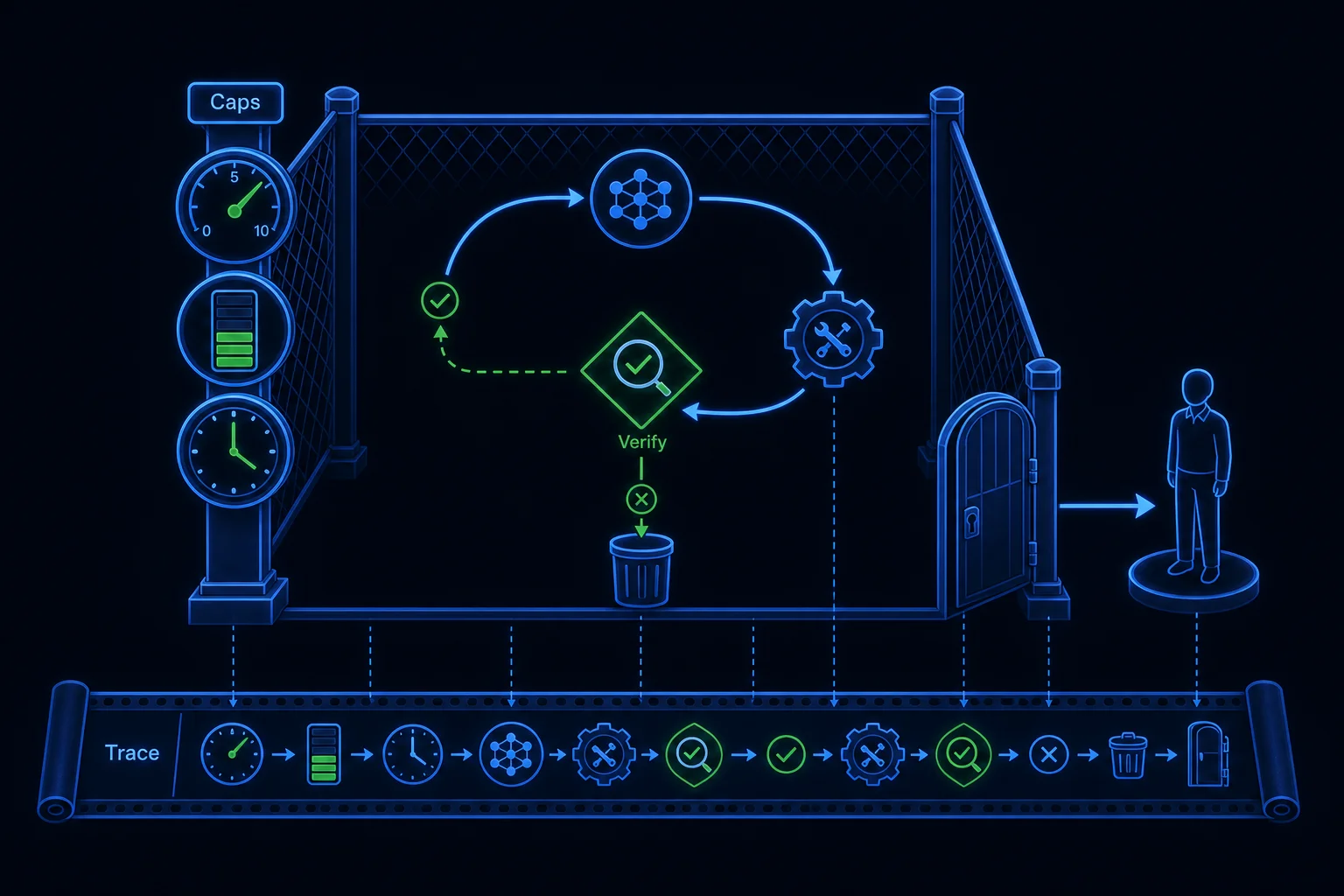
Bound the loop and the budget
The first defense is making runaway impossible by construction:
- Cap iterations. A hard maximum number of turns stops a confused agent from looping endlessly. When the cap is hit, fail loudly rather than letting it run.
- Cap tokens and time. Track cumulative token cost and wall-clock across the whole run, not per call. End the run when either ceiling is reached.
- Limit the toolset. Only expose the tools the task actually needs. Every extra tool is another way to go wrong and another thing to secure.
These limits are cheap to add and turn the worst failure modes — infinite loops, surprise bills — from possible into impossible.
Verify every step
Don't trust that an action succeeded just because the model moved on. After each tool call, check the result before feeding it back into the loop:
- Did the tool actually succeed, or return an error the model might ignore?
- Is the output the right shape? Validate against a schema and reject what doesn't match.
- Does the result make sense for the goal, or has the agent drifted off course?
A verified result keeps a single bad turn from poisoning every turn after it. An unverified one compounds.
Fail closed and log everything
Two habits separate a demo agent from a production one.
Fail closed. On uncertainty — a tool outage, low-confidence output, an ambiguous goal — the agent should refuse or escalate to a human, never guess and barrel ahead. A wrong action an agent takes is far costlier than a question it asks.
Log every step. Record the full trace: each observation, the model's decision, the tool called, the result, and the tokens spent. Because agent failures are silent and the path differs every run, that trace is the only way to debug what happened, audit what was done, and bound your costs. Treat it as a hard requirement, not an afterthought — it's the same discipline LyraLearn applies to its single-call Tutor, scaled up to a loop.