What Is MCP
Every AI feature eventually needs to reach outside the model — to query a database, read a document, call an internal API, or file a ticket. The naive approach is to hand-write a bespoke integration for each tool and each AI application. That doesn't scale: N applications times M tools is N×M one-off connectors to build and maintain. The Model Context Protocol (MCP) is an open standard that collapses that to N+M — you wrap a system once and any MCP-aware application can use it.
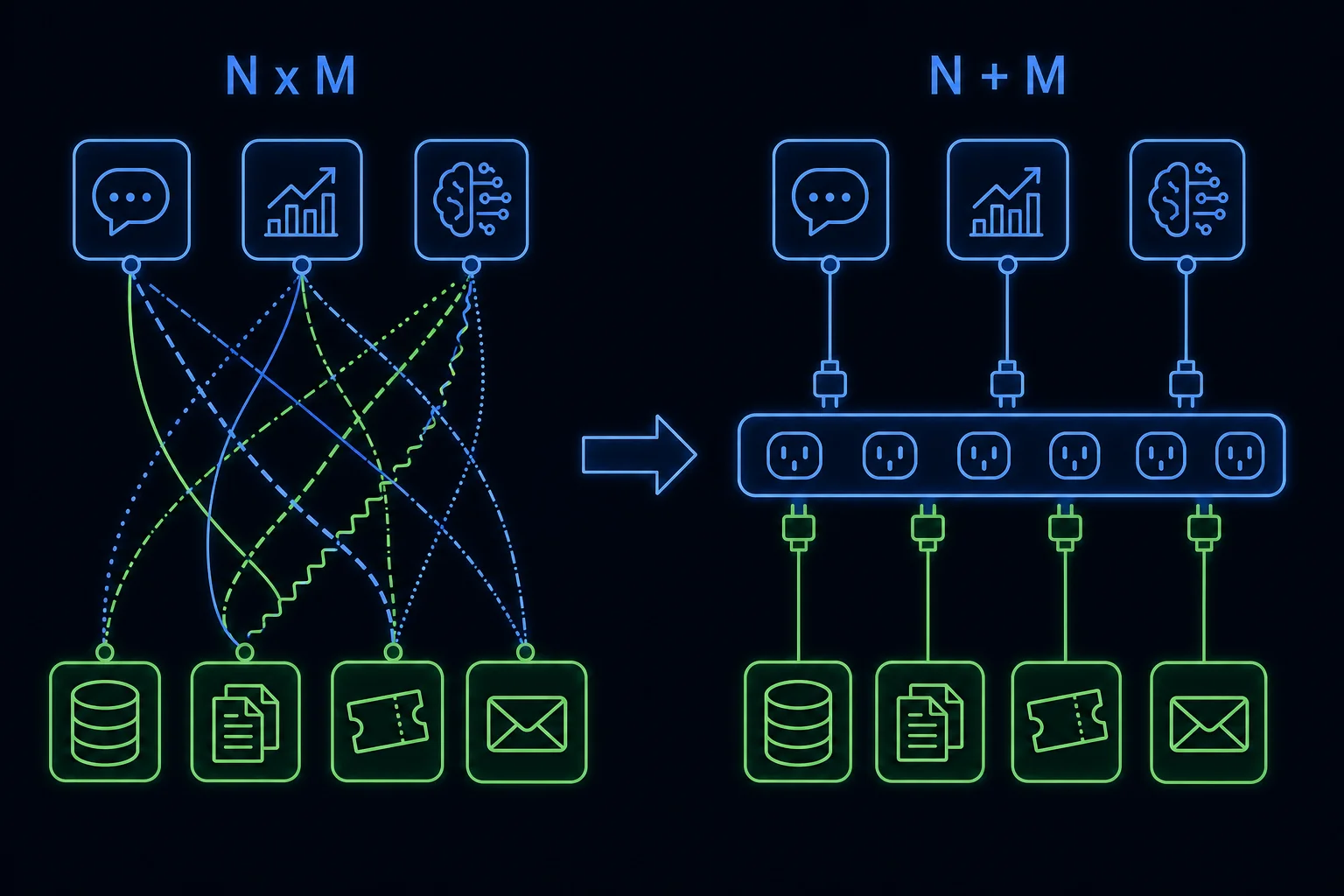
The problem MCP solves
Before MCP, connecting an LLM to your SQL database meant writing custom glue: a tool schema, an auth flow, serialization, error handling — all specific to one model SDK. Switch models or add a second AI app and you rewrite it. MCP defines a uniform interface between AI applications and external capabilities, the same way ODBC standardized database access or LSP standardized editor language support. Build the integration once, reuse it everywhere.
What MCP standardizes
MCP is a wire protocol (JSON-RPC over stdio or HTTP) plus a small set of well-defined primitives that a server can expose:
- Tools — actions the AI can invoke, each with a typed input schema. "Run this SQL query," "create a ticket," "send an email."
- Resources — read-only data the AI can pull into context: files, records, documents, database rows.
- Prompts — reusable, parameterized prompt templates a server offers to clients.
A model never talks to your database directly. It asks its host application to call a named tool; the host routes that through MCP to the server, which executes against the real system and returns a structured result. The model only ever sees a clean, declared contract.
Why an architect should care
MCP turns integrations into reusable, governable assets instead of scattered glue code. The same SQL-database server you write for your support chatbot serves your analytics agent and your internal copilot unchanged. Capabilities become discoverable — a client can ask a server "what tools do you offer?" at runtime. And because the boundary is explicit and typed, it's exactly the place to enforce authentication, scoping, and auditing (Module 8.4).
The standard is model-agnostic and increasingly first-class on .NET and Azure: official C# SDKs let you author MCP servers as ASP.NET Core services and consume them from any host. For an enterprise, that means your existing systems — wrapped once as MCP servers — become a shared capability layer that every future AI initiative can build on.