The AI Threat Model
Before you can secure an AI feature, you have to name what you're protecting and what can go wrong. A traditional threat model asks "who can reach this endpoint and what can they do?" An AI threat model adds a harder question: the system now processes untrusted natural language as if it were intent, and that text can come from a user, a retrieved document, or a tool result. An AI architect builds the threat model first — everything else in this module is a response to it.
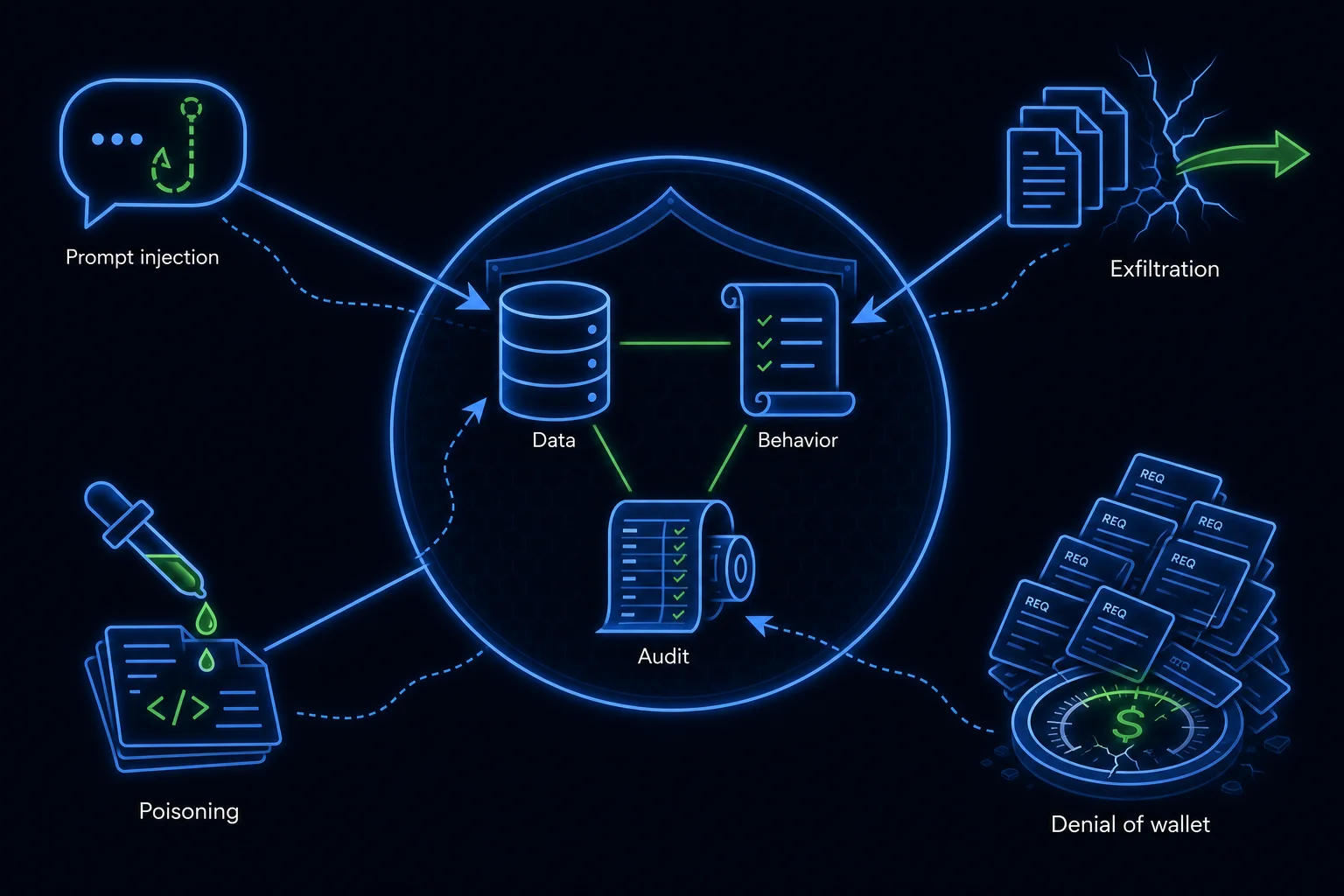
Assets to protect
Three assets matter in almost every enterprise deployment:
- Data. The records you send to a model (PII, case files, internal documents) and the knowledge base behind retrieval. This is the thing regulators and citizens care about most.
- Model behavior. The system's instructions and guardrails — the "personality" and policy that keep it on-task. If an attacker can rewrite behavior, they own the feature.
- The audit trail. Who asked what, what the model saw, what it answered. In public-sector work this is not optional: you must be able to reconstruct any decision after the fact.
If you can't say which of these a given control protects, it probably isn't pulling its weight.
Threats to anticipate
- Prompt injection. Hostile text — direct from a user or hidden in retrieved content — that hijacks the model's instructions. The defining LLM risk; Module 11's next lesson goes deep.
- Data exfiltration. Coaxing the model to reveal data it was given access to, or to smuggle secrets out through its output.
- Model and output abuse. Using the feature to generate harmful, biased, or off-policy content, or to launder a prohibited action through a plausible answer.
- Knowledge-base or training-data poisoning. Planting malicious content in a source the system ingests, so the attack fires later when that content is retrieved. A supply-chain attack on your data, not your code.
- Denial of wallet. Driving cost or latency through expensive prompts, huge context, or request floods until the budget — or the service — breaks.
Mapping to expectations
Public-sector and enterprise reviews increasingly expect AI features to map to recognized controls — NIST-style confidentiality, integrity, availability, and the NIST AI RMF's govern / map / measure / manage loop. The value of a written threat model is that it lets you point at each control and say which asset it protects and which threat it answers — exactly what an assessor will ask.
How LyraLearn applies this
LyraLearn names its assets explicitly: lesson data and embeddings (data), the Tutor's system instructions (behavior), and the request/answer log (audit trail). Its local-first embeddings keep most data on-platform, its allow-listed ingestion resists poisoning, and per-request limits cap denial-of-wallet exposure. The platform is its own worked example — every later lesson traces back to a named threat here.