SQL Server 2025 Native Vectors
For years, adding semantic search to a .NET application meant bolting a separate vector database
onto your stack. SQL Server 2025 changes that by making vector a first-class column type,
with built-in distance functions, so embeddings live right next to the relational data they
describe. For enterprise and public-sector teams already running SQL Server, this is the single
biggest practical simplification in applied AI architecture.
The vector type and VECTOR_DISTANCE
You declare a column with a fixed dimension count, matching whatever your embedding model emits:
ALTER TABLE LessonChunks ADD Embedding vector(768);
You store an embedding as you'd expect from C# — pass the 768-float array (serialized as JSON) to
a parameter and INSERT it. To search, you embed the user's question and rank rows by closeness:
SELECT TOP (5) ChunkId, Content,
       VECTOR_DISTANCE('cosine', Embedding, @queryVector) AS Distance
FROM LessonChunks
ORDER BY Distance;
VECTOR_DISTANCE supports 'cosine', 'euclidean', and 'dot'. Match the metric to your
embedding model — most text models (and LyraLearn) are tuned for cosine. This query is exactly
how the LyraLearn AI Tutor retrieves: the question becomes a vector(768), SQL Server scores every
chunk, and the nearest passages flow into the grounded prompt you met in Module 3.
One database, no separate store
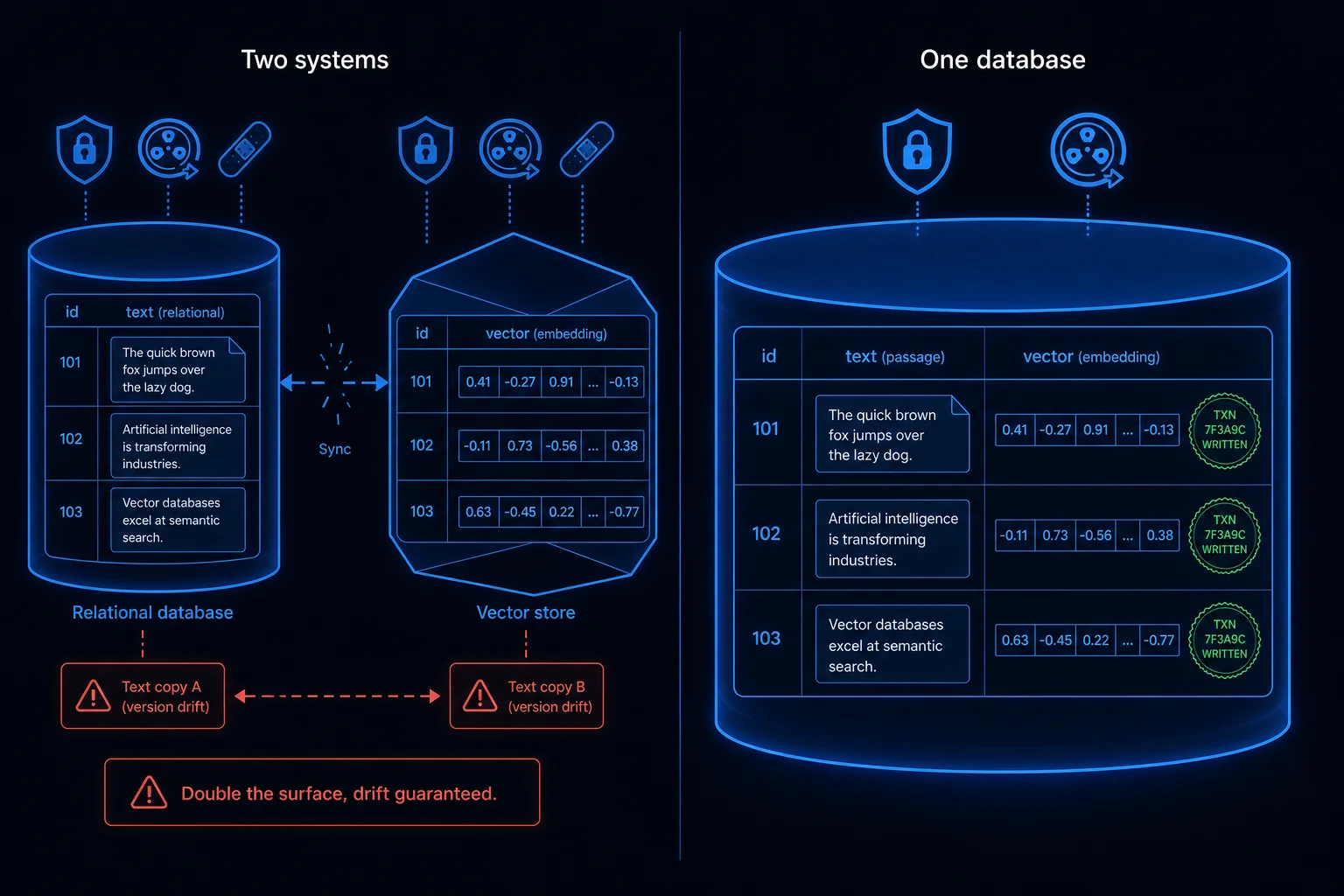
The architectural payoff is operational, not algorithmic. With a separate vector store you run two systems and must keep them consistent: every time a lesson is edited, both the SQL row and the external vector record have to update, or your search silently goes stale. You also double the surface you back up, secure, patch, and monitor — and in public-sector work, every extra data store is another thing to certify and audit.
Native vectors collapse all of that:
- One transaction writes the content and its embedding together — they can never drift.
- One backup and restore covers relational and semantic data.
- One security boundary — existing row-level security, encryption, and access controls apply to embeddings automatically, with no new system to govern.
- Real joins — you can filter vector results by ordinary columns (
WHERE ModuleId = @m) in the same query, no cross-system glue.
When a dedicated store still earns its place
This is not "never use a vector database." If you're at hundreds of millions of vectors, need specialized index tuning, or already run a vector-native platform, a dedicated store can be the right tool. But that is a smaller slice of real projects than the hype suggests. For the typical enterprise app — a knowledge base, a support assistant, a tutor like this one — native SQL Server vectors are the realistic, lower-risk default. LyraLearn deliberately uses no separate vector database, and that is a feature of the design, not a shortcut.