The Enterprise AI Stack
An AI feature in a serious organization is never just "call a model." It sits on a stack of layers, each owned and reasoned about by the architect. Understanding these layers is what separates a demo from a system you can run, secure, and defend in a review.
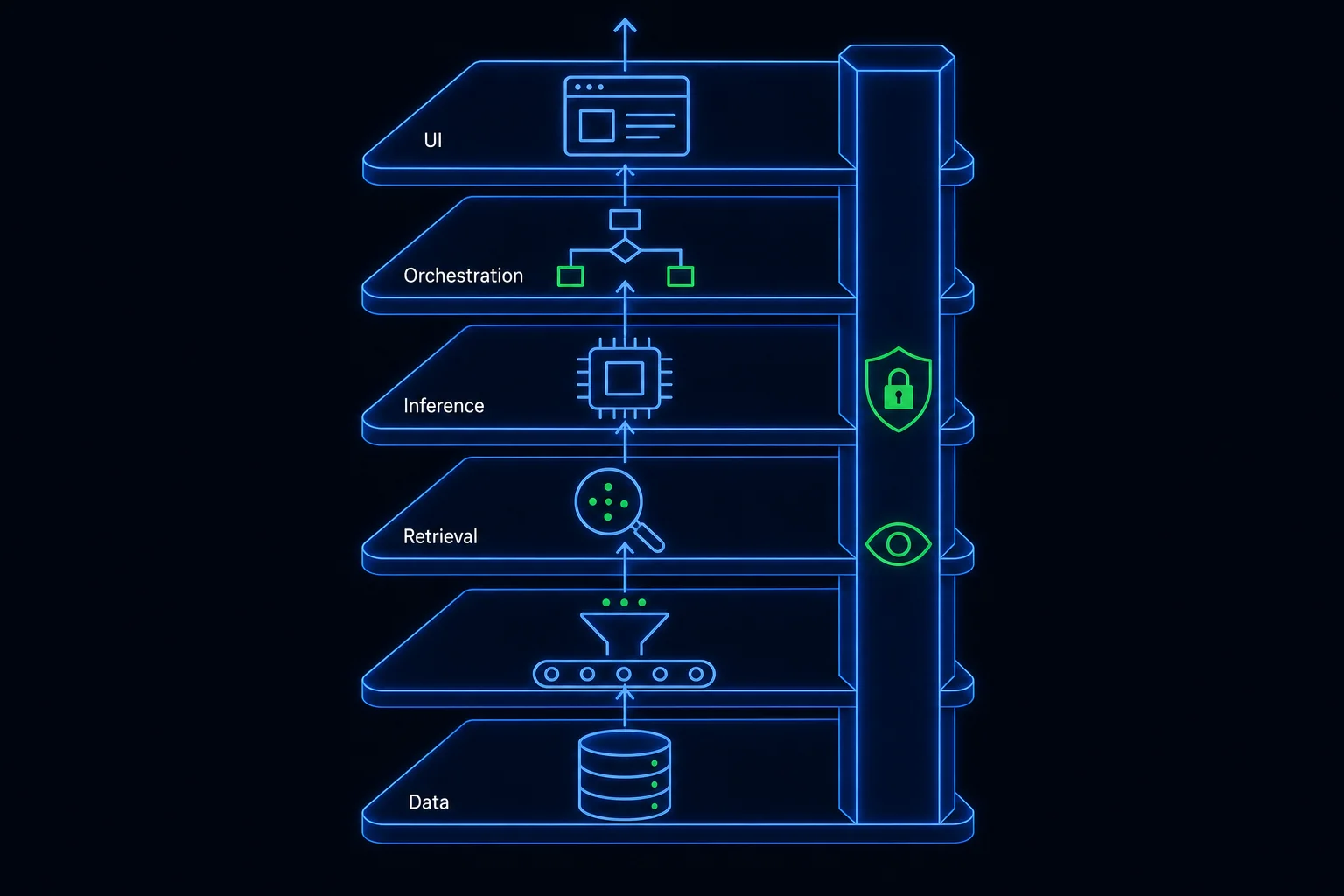
The layers
From the bottom up, a typical enterprise AI feature looks like this:
- Data & sources — the documents, records, and content the AI is allowed to see. In a .NET shop this is usually SQL Server, plus content systems like SharePoint or a CMS.
- Ingestion & indexing — a service that pulls approved content in, splits it into chunks, and turns each chunk into an embedding for search. This is a pipeline, not a one-off.
- Retrieval — given a question, find the most relevant chunks (vector + keyword search).
- Inference — the model call itself: embeddings (often local) and generation (local or cloud), behind an interface so the provider can change.
- Orchestration — the application logic that wires retrieval, prompting, validation, and guardrails together into a use-case.
- Presentation — the API and UI the user actually touches.
- Cross-cutting — security, observability, audit, and governance, present at every layer.
Why the stack matters
Each layer is a place to enforce a quality goal. Security lives at the data and inference layers (what can the AI see; where does data go). Correctness lives at retrieval and orchestration (is the answer grounded; was it validated). Cost lives at inference (local vs cloud). Observability spans all of them.
When something goes wrong — a hallucinated answer, a leaked record, a runaway bill — the architect's first move is to ask which layer failed. A platform without clear layers gives you nowhere to look.
How LyraLearn maps to the stack
This very platform is built on these layers, which makes it a working reference:
- Data: SQL Server (lessons, knowledge-base documents, embeddings).
- Ingestion: a background importer that chunks and embeds lesson content.
- Retrieval: SQL Server 2025 native vector search.
- Inference: local embeddings + local/cloud generation behind interfaces.
- Orchestration: the AI Tutor service (retrieve → grade → ground → answer).
- Presentation: this web app and its API.
- Cross-cutting: audit logs and an evaluation record for every AI call.
As you move through the course, you'll build each of these layers yourself.