The Azure AI Landscape
When an Azure-and-.NET shop decides to put AI into production, it rarely starts by renting GPUs. It reaches for managed services — Azure's hosted building blocks that handle scaling, patching, and compliance so your team can focus on the application. Knowing which service does what is the first step in any architecture decision.
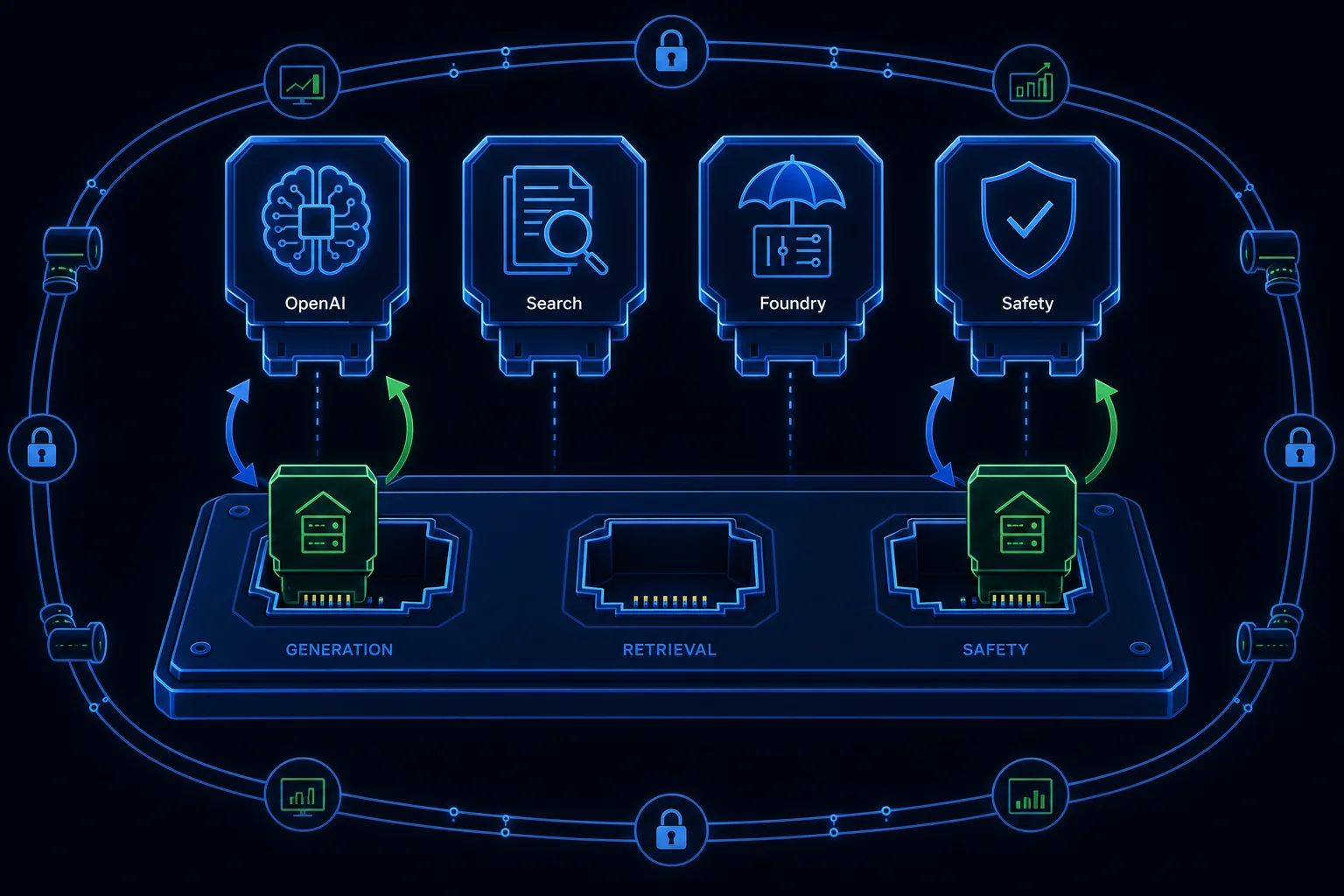
The services you actually reach for
A handful of services cover the vast majority of enterprise AI work:
- Azure OpenAI Service — hosted GPT and embedding models behind Azure's security and compliance boundary. Your generation and embedding calls go here when you want a frontier model without managing it yourself.
- Azure AI Search — managed vector and hybrid search. This is "RAG as a managed service": it indexes your documents, embeds them, and serves relevance-ranked results.
- Azure AI Foundry — the umbrella portal and SDK for building, evaluating, and deploying AI applications. It's where you manage model deployments, run evaluations, and wire agents together.
- Azure AI Content Safety — a moderation service that scores text and images for harmful categories, used to guard both user input and model output.
You won't use all four on day one, but most production systems end up combining a generation model (Azure OpenAI), a retrieval layer (AI Search or a database), and a safety gate (Content Safety).
How it fits the Azure ecosystem
The reason an Azure shop picks these over running models itself is integration, not raw capability:
- Entra ID (formerly Azure AD) provides authentication. Services authenticate to each other with managed identities instead of API keys, so no secret ever lands in a config file.
- Azure DevOps / GitHub Actions deploy model configurations and infrastructure as code, so an AI deployment is reviewed and promoted like any other release.
- Azure Monitor and Application Insights capture latency, token usage, and errors alongside the rest of your telemetry.
Where LyraLearn fits
LyraLearn runs local-first — local embeddings and a local chat model behind interfaces — but it
is built to slot into exactly this landscape. Because every AI capability sits behind an interface
like IChatCompletionService or IEmbeddingService, adopting Azure OpenAI is a registration and
config change, not a rewrite. The same is true for retrieval: today LyraLearn uses SQL Server
vectors, but the IVectorStore abstraction means Azure AI Search could back it tomorrow. The
landscape is a menu of swappable components, and good architecture keeps every choice on the table.