Azure AI Search
Azure AI Search is a managed search service that has become Microsoft's go-to retrieval layer for RAG. It indexes your content, stores embeddings, and serves relevance-ranked results — so instead of building and operating a vector store yourself, you provision an index and call an API. It's best understood as "RAG as a managed service."
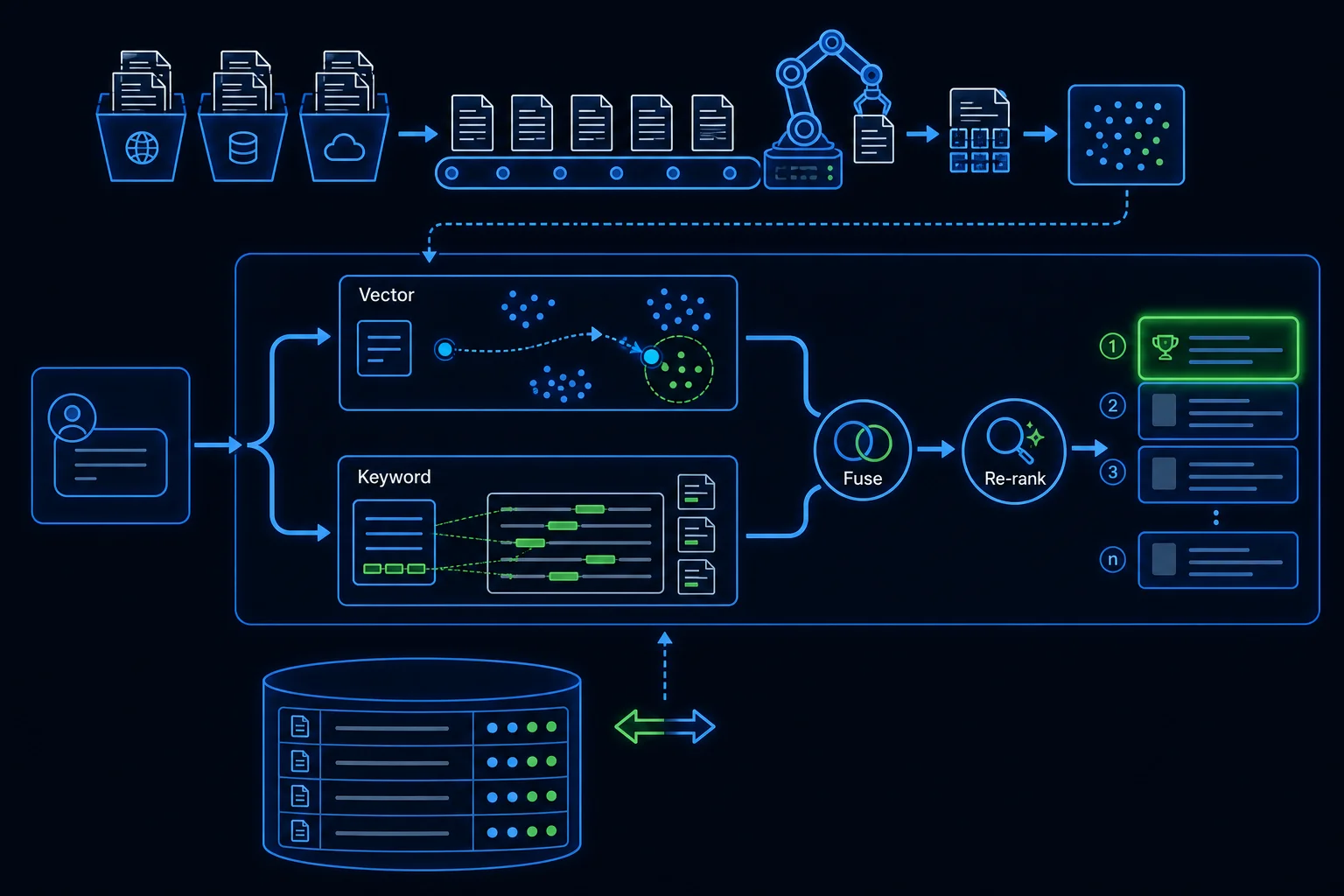
Vector and hybrid search, managed
The reason AI Search shows up in so many RAG designs is that it does more than nearest-neighbor lookup over vectors:
- Vector search finds semantically similar chunks using embeddings — the core of any RAG retrieval step.
- Keyword (BM25) search still matters for exact terms, product codes, and names that embeddings blur together.
- Hybrid search runs both and fuses the scores, and semantic ranking re-orders the top results with a language model. In practice hybrid + semantic ranking beats pure vector search on enterprise documents, where precise terminology is common.
It also handles the unglamorous parts: an indexer can pull from Blob Storage, SQL, or Cosmos DB, chunk documents, call an embedding model, and keep the index fresh on a schedule — work you'd otherwise hand-build into an ingestion pipeline.
When to use it versus SQL Server 2025 vectors
SQL Server 2025 ships native vector types and similarity functions, so you can now do vector search inside the database that already holds your data. The choice between the two is a real architectural decision:
- Reach for SQL Server vectors when your content already lives in SQL, volumes are moderate, and you value keeping retrieval in one transactional system — no extra service, no data sync, and your embeddings sit next to the rows they describe. This is exactly what LyraLearn does.
- Reach for Azure AI Search when you need large-scale indexing, built-in hybrid and semantic ranking, multi-source ingestion across many document stores, or a search experience richer than similarity alone — and you're willing to run and pay for a dedicated service.
A useful rule of thumb: if vector search is a feature of your data, keep it in SQL Server; if search is a product in its own right, AI Search earns its keep.
Keep retrieval behind an interface
The same discipline that protects model choice protects retrieval choice. LyraLearn hides its vector
store behind an abstraction such as IVectorStore, with SQL Server backing it today. Swapping in an
Azure AI Search implementation means writing one adapter and changing registration — the RAG
pipeline, prompts, and tutor logic never know the difference. Retrieval, like the model, stays a
replaceable component.