Choosing Azure vs Local
Local models and Azure's managed services are not rivals to pick between once and forever — they are two ends of a spectrum, and mature systems use both. The architectural goal is to make the choice per workload, and reversible, so you route each task to whichever side fits its constraints.
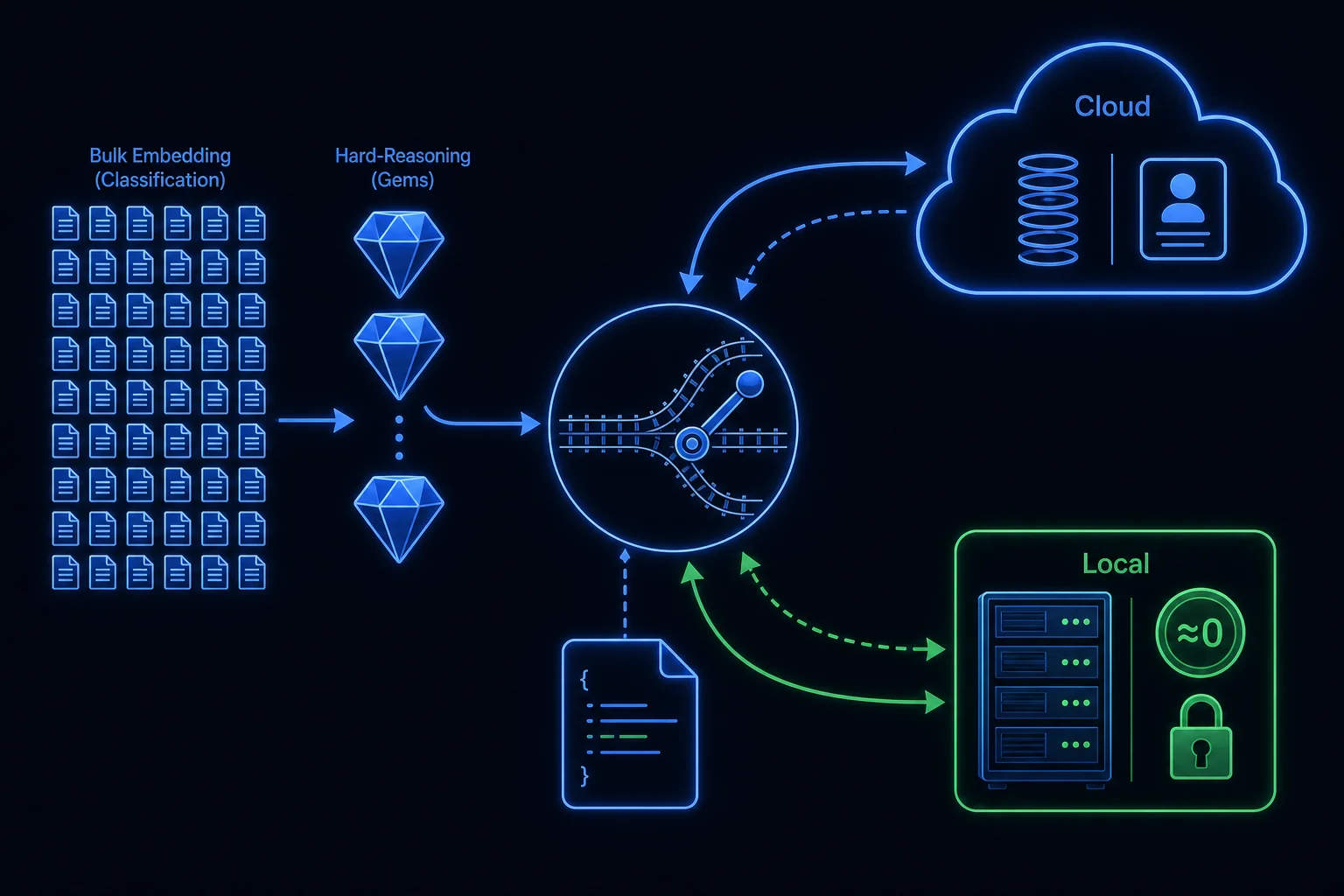
The trade-offs that decide it
The same axes from model selection — capability, latency, cost, privacy — point in different directions depending on the workload:
- Cost at volume — local inference has a fixed hardware cost and near-zero marginal cost per call. High-volume work (embedding a whole corpus, classifying every record) is dramatically cheaper local. Azure's per-token pricing rewards bursty, lower-volume use.
- Privacy and residency — if data legally cannot leave your boundary, local keeps it in-house. Azure answers the same need differently: regional deployments and a no-training guarantee can satisfy many compliance regimes without you operating the model.
- Managed scale — Azure absorbs scaling, patching, failover, and capacity planning. Local means you own uptime, GPU provisioning, and model updates.
- Capability ceiling — frontier cloud models still out-reason what you can comfortably self-host, so the hardest reasoning often justifies a cloud call.
A decision framework
A practical default for an enterprise .NET shop:
- High-volume, cost- or privacy-sensitive, routine work → local. Embeddings, bulk classification, and Q&A over retrieved context rarely need a frontier model, and keeping them local controls both cost and data.
- Hard reasoning on non-sensitive data → Azure OpenAI. Mentoring, nuanced judgment, and architecture review are where a frontier model's quality justifies the per-call cost.
- Compliance, enterprise integration, or unpredictable scale → Azure. When you need Entra ID auth, audited regional residency, or elastic capacity more than you need marginal-cost savings, the managed path wins.
This is the hybrid posture: local for the high-volume floor, Azure for the demanding ceiling.
Why the architecture makes this cheap
None of this is a one-way door for LyraLearn, because the model and the vector store both live behind interfaces. The platform runs local-first today, but moving any single workload to Azure OpenAI or Azure AI Search is a dependency-injection and config change — register the Azure-backed provider, point config at it, leave every use-case untouched. You can even route different features to different providers by policy. "Azure or local" is therefore not an architecture you commit to; it's a decision you can revisit per workload, forever — which is exactly what swappable design buys you.