Data Protection and Privacy
The moment you send data to a model, you've made a privacy decision — often without realizing it. Every prompt is a data flow: text leaves your trust boundary, travels to a provider, may be logged or used to improve a service, and comes back. For enterprise and especially public-sector work, that flow has to be deliberate, documented, and defensible. An AI architect treats "which data goes where" as a design constraint, not an afterthought.
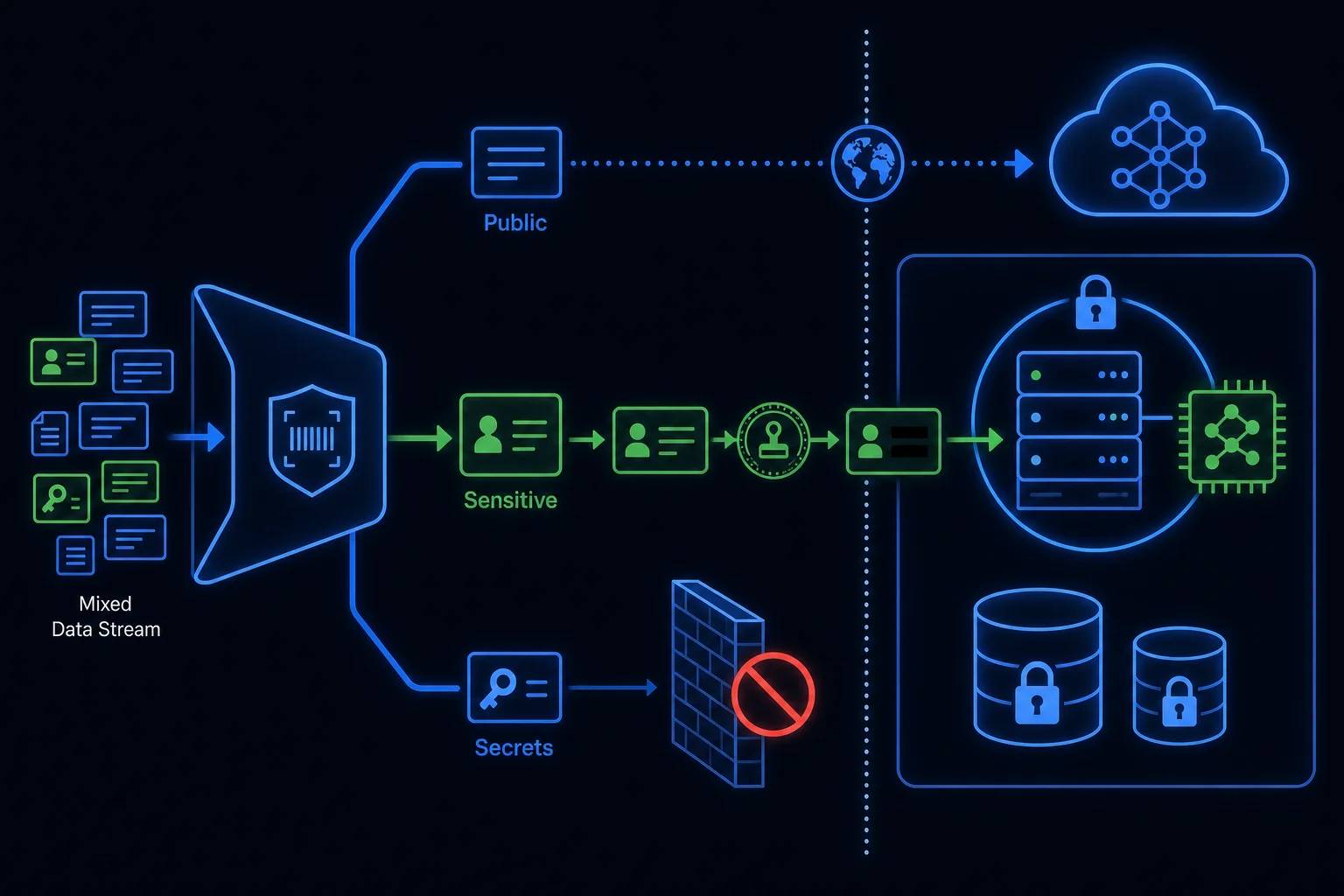
Which data goes to which provider
Not all data deserves the same destination. Classify before you route:
- Public or low-sensitivity content can go to a hosted frontier model for the best quality.
- Internal or regulated data (PII, case records, anything covered by a data-protection agreement) should stay on systems you control, or go only to a provider under contract with the right data-handling terms.
- Secrets and credentials never go into a prompt. Ever.
The architectural lever here is local-first as a privacy control. Running embeddings and, where possible, inference on-platform means sensitive text never crosses a third-party boundary. Local- first isn't just a performance or cost choice — it's the strongest privacy guarantee you can offer, because data that never leaves can't be leaked, logged, or subpoenaed elsewhere.
Minimize, encrypt, and document
Three practices make the difference between a passable design and an auditable one:
- PII minimization. Send the model the least data needed to answer. Redact or tokenize identifiers before they enter a prompt; retrieve passages, not whole records. The cheapest data to protect is the data you never sent.
- Encryption at rest. Embeddings, cached prompts, retrieved chunks, and the audit log are all data — encrypt them in storage (SQL Server TDE / column encryption, encrypted volumes) and in transit (TLS everywhere). Treat the vector store with the same care as the source database.
- Documented cross-border data flow. Write down where data physically goes — region, provider, sub-processors — and keep it current. Data residency is a hard requirement in much public-sector work, and "we don't know where the prompts go" fails a review on its own.
Mapping to expectations
These map cleanly onto NIST-style controls and common privacy frameworks: data minimization, access control, encryption, and a maintained record of processing. The point of writing them down is the same as in the threat model — an assessor can trace each control to the data it protects.
How LyraLearn applies this
LyraLearn computes embeddings locally so lesson and learner data stays on-platform; PII never enters the retrieval path because it indexes lesson content, not personal records. Stored embeddings and logs sit in an encrypted SQL Server 2025 database, transport is TLS-only, and the (small, well-defined) set of external calls is documented — so the cross-border story is a sentence, not a mystery.