Secure AI SDLC
The defenses in this module only hold if they survive contact with a real development pipeline. A clever prompt-injection guard is worthless if the next deploy ships a leaked API key, an over-privileged database login, or a dependency with a known CVE. Secure AI SDLC means folding AI-specific risks into the same automated, every-commit discipline you already apply to code — so security is enforced by the pipeline, not by whoever remembered to check. An AI architect owns this wiring.
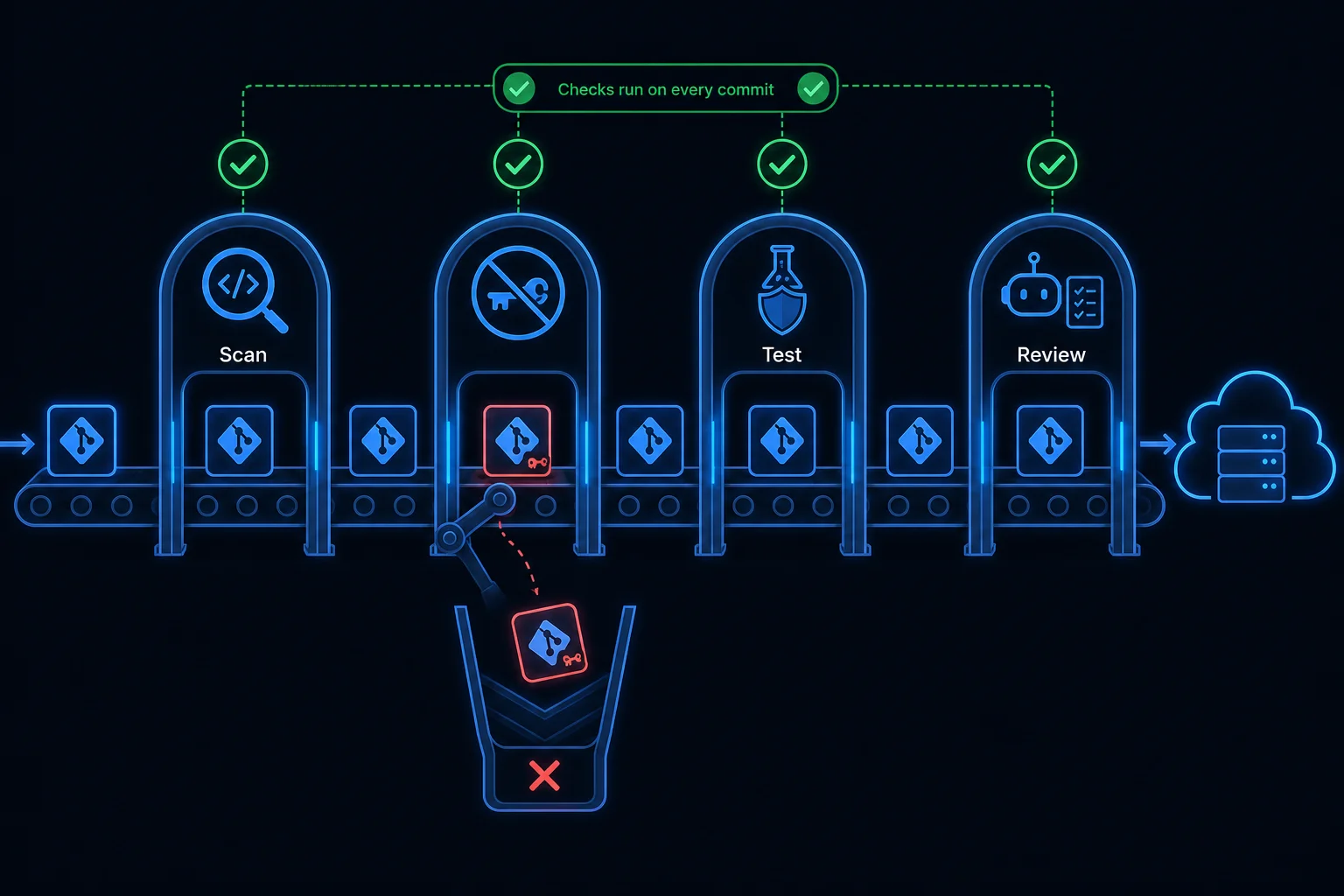
Build the controls into the pipeline
Most of what protects an AI system is ordinary application-security hygiene, run consistently:
- Static analysis (SAST). Run analyzers on every build — for .NET, the Roslyn analyzers and security rules — to catch injection sinks, unsafe deserialization, and missing output encoding before they merge.
- Dependency and secret scanning. Scan the dependency graph for known-vulnerable packages and scan the diff for committed secrets. The model SDK, vector libraries, and prompt templates are all supply chain — treat them as such. A leaked key is a one-commit breach.
- Least-privilege DB logins. The app's database login should be able to do exactly what the
feature needs and nothing more — read the lesson tables and the vector index, not
DROP TABLE, not cross-database reads. If injection ever does reach a tool, least privilege is what caps the blast radius. - Guardrails as code, tested. The injection defenses from lesson 2 — instruction separation, no-tools-in-trust-path, output escaping, fail-closed — are code paths with regression tests. A guardrail without a test is a guardrail one refactor away from gone.
Close the loop with AI review
The most fitting control for an AI platform is to turn the AI on its own pipeline. An AI code reviewer can enforce the very controls this module teaches: flagging a new model call that ships data to an un-vetted provider, a tool wired into the answer path, an output that reaches a sink unescaped, or a DB login granted more than it needs. It doesn't replace SAST and human review — it adds a reviewer that understands AI-specific failure modes, applied uniformly on every change.
Mapping to expectations
This is the manage phase of the NIST AI RMF and the SDLC controls public-sector assessors expect: documented secure-build practices, vulnerability management, least privilege, and continuous monitoring. The pipeline is your evidence — green checks on every commit are easier to defend than a one-time security sign-off.
How LyraLearn applies this
LyraLearn runs SAST, dependency, and secret scans in CI on every commit; its runtime DB login is scoped to the lesson and embedding tables with no schema or admin rights; and its guardrails carry regression tests so a refactor can't silently remove them. Fittingly, the platform's own AI code reviewer enforces the controls these lessons describe — the system practices what it teaches, which is the whole point of LyraLearn being its own worked example.