The Five Solutions
The blueprint describes five practical solutions an enterprise on .NET / Azure / SQL Server genuinely needs. None is academic — each maps to a real workflow inside an organization (think a state teacher-credentialing agency, a public-sector body, or any content-heavy enterprise). They are deliberately different on the surface but share one core underneath, which is the subject of the next lesson. Here, learn what each one does.
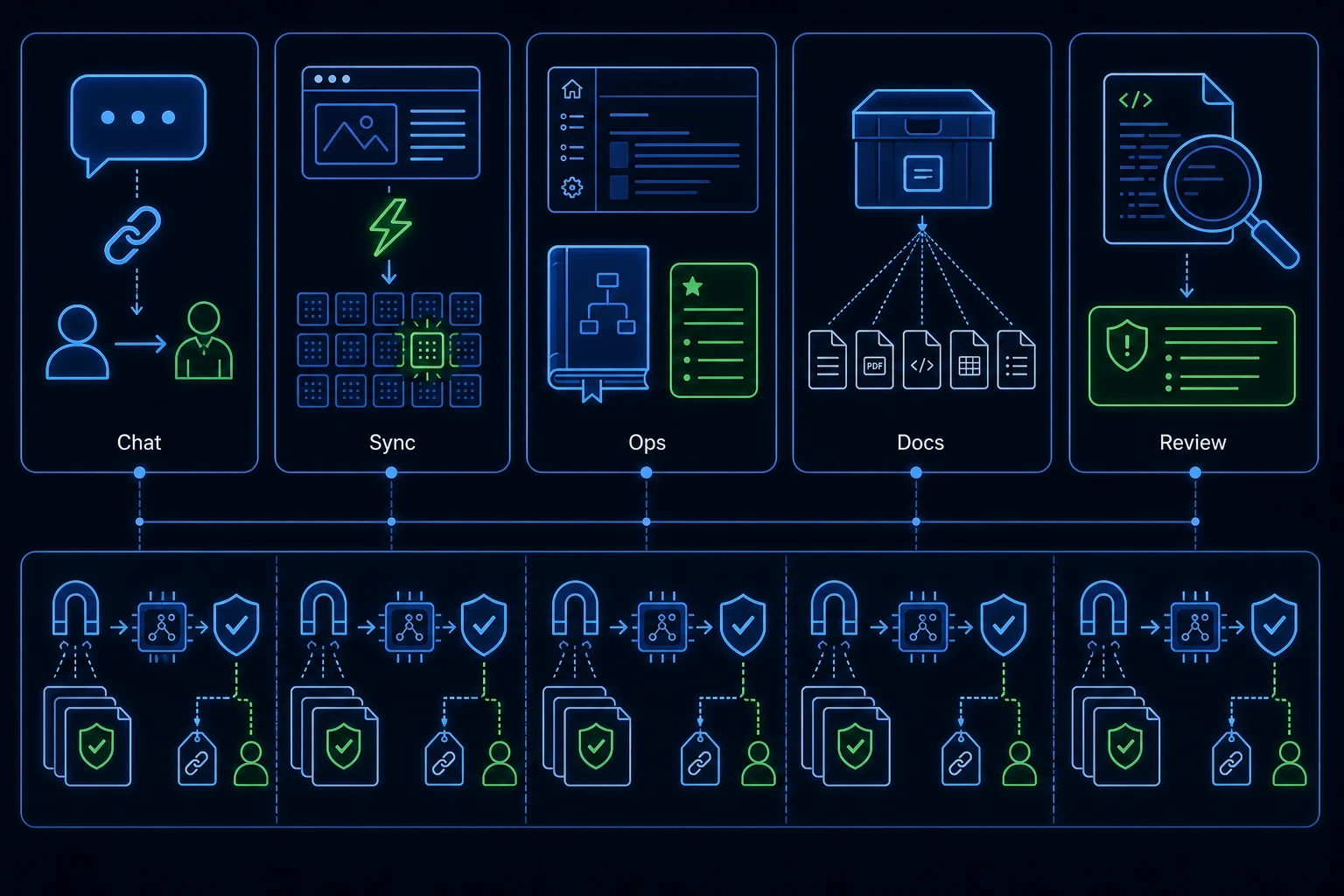
Solution 1 — Teacher Credential Guidance Assistant
A RAG chatbot that answers credential questions strictly from approved public content. It is
the flagship and the one you can touch live at ctc.lyracreation.com. The architecture-critical
features are not the chat UI — they are the source citations on every answer, hallucination
mitigation (the model answers from retrieved passages, not memory), and human escalation when
confidence is low or the question falls outside approved content. This is grounding, validation, and
fail-closed behavior made concrete.
Solution 2 — WordPress AI Sync
Approved content usually lives in a CMS. This solution keeps the AI's knowledge fresh and trusted. WordPress hooks/webhooks fire when content changes and trigger an ASP.NET ingestion service that re-chunks and re-embeds only the CHANGED content — not the whole corpus — plus a nightly reconciliation pass to catch anything a webhook missed. The architecture lesson here is incremental, event-driven ingestion with a safety-net batch job, so the assistant never answers from stale or unapproved material.
Solution 3 — AI Operations Assistant
An internal-staff helper that turns the AI on the operators, not the public. It assists with PowerShell jobs, data and exam imports, report generation, log summarization, and troubleshooting, grounded in the organization's runbooks. The judgment on display is keeping a powerful assistant bounded — it works from approved runbooks and surfaces recommendations, rather than executing destructive operations blindly.
Solution 4 — AI Repository Initialization Platform
Given a repository, this generates a complete onboarding doc set: README, ARCHITECTURE, CODING-STANDARDS, CONTRIBUTING, SECURITY, RUNBOOK, and AI-INSTRUCTIONS. The goal is to make a codebase legible to Copilot, agents, and new developers at once. It demonstrates that AI architecture isn't only runtime — it also improves the developer experience and agent-readiness of the engineering organization itself.
Solution 5 — AI Code Review Assistant
Reviews C#, ASP.NET, SQL, and PowerShell against the standards the previous solution writes down. It checks for standards, security, logging, architecture compliance, naming, and maintainability, and returns recommendations with risk assessments — not just pass/fail. This closes the loop: docs define the rules, review enforces them.
The pattern across all five
Read them together and a shape emerges. Each is retrieve approved context → reason → produce a validated, cited, escalatable output. That repeated shape is exactly why they can share one core — which is what you'll design next.