The AI Architecture Blueprint
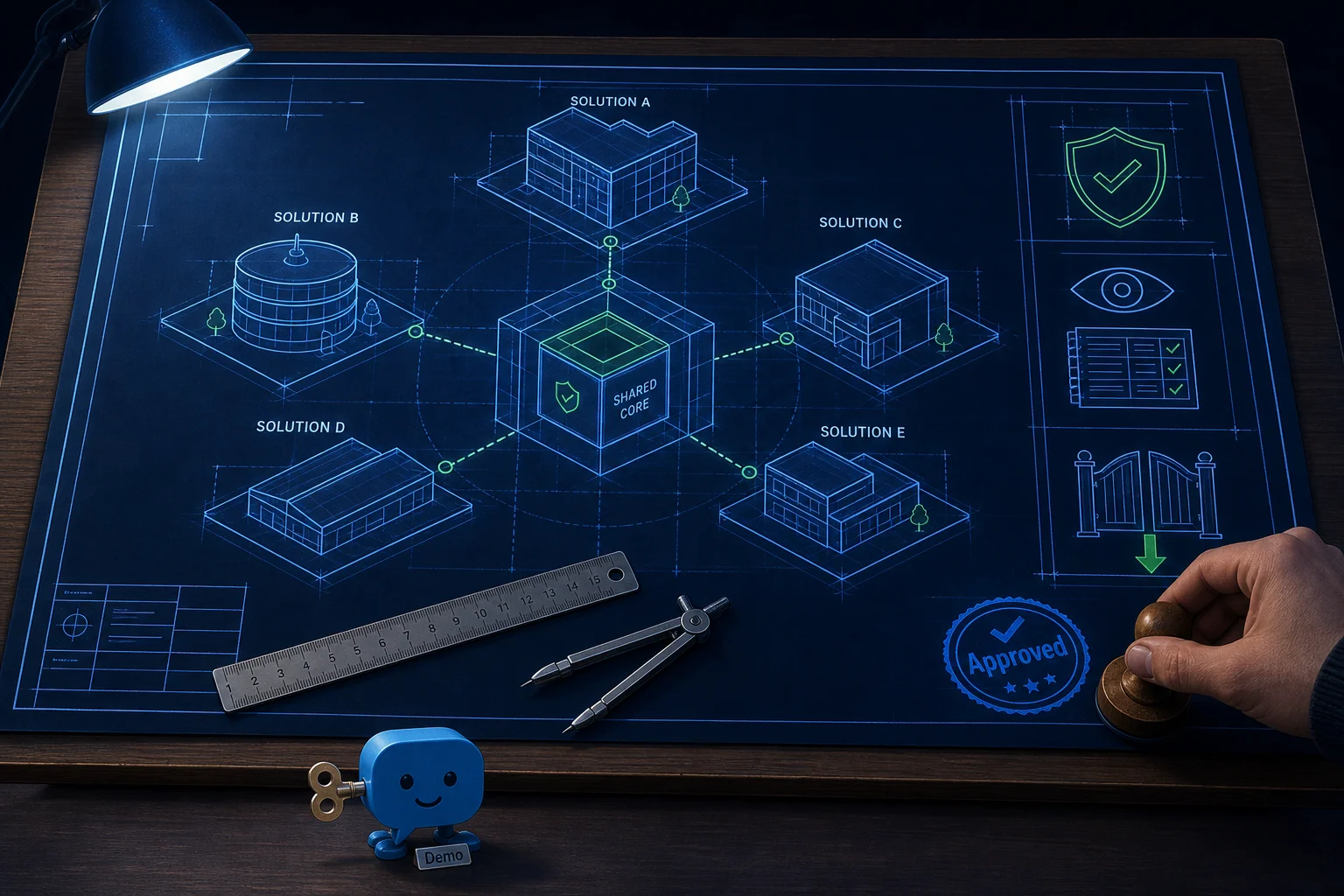
The capstone of this course is not a chatbot. It is an AI Architecture Blueprint — a portfolio-quality design document for a real .NET / Azure organization that shows you can think like an architect, not just wire up an API call. The blueprint describes five practical solutions that an enterprise actually needs, all built on one reusable RAG core and a shared AI plumbing layer. The deliverable is the thinking made visible: the diagrams, the trade-offs, the guardrails, and the governance story that a public-sector reviewer would sign off on.
Why a blueprint, not a demo
Anyone can stand up a single RAG chatbot in an afternoon. That demonstrates plumbing skill, not architecture judgment. The blueprint raises the bar by forcing the questions an organization will actually ask:
- Reuse — do five different AI features each get their own bespoke stack, or do they share one hardened core? (The whole point of the capstone is the latter.)
- Governance — where does approved content come from, how is it versioned, and how do you prove to a reviewer that the system can't leak or hallucinate its way into a liability?
- Operations — who runs this at 2 a.m., how do they see what the AI did, and how does it fail closed when it's unsure?
A blueprint that answers those is a far stronger portfolio piece than a working toy, because it demonstrates the judgment that distinguishes an AI architect from an AI tinkerer.
What goes in the blueprint
Your finished blueprint is a small set of artifacts, each of which you've already practiced in earlier modules:
- A context/landscape diagram — the organization, its content sources, and where the AI sits.
- The shared-core design — the single RAG + plumbing layer every solution reuses.
- Five solution sketches — each described as problem → data flow → guardrails → escalation.
- A security & governance mapping — grounding, validation, fail-closed behavior, audit logging.
- An operations view — observability, runbooks, and human-in-the-loop escalation paths.
This course is the worked example
You are not designing in the abstract. LyraLearn itself — the platform you're reading this on —
and the live demo at ctc.lyracreation.com are the worked build of this very blueprint: a RAG
assistant answering from approved public content, with citations, hallucination mitigation, and
human escalation. Over the next three lessons you'll catalogue the five solutions, tell the
reuse story that ties them together, and assemble everything into a portfolio and an interview
narrative that proves AI-architect judgment.