Coordination Patterns
Once you have more than one agent, something has to decide who does what, in what order, and how results come back together. A few coordination patterns cover the large majority of real systems. Pick the simplest one that fits the task — coordination is where multi-agent complexity and cost actually live.
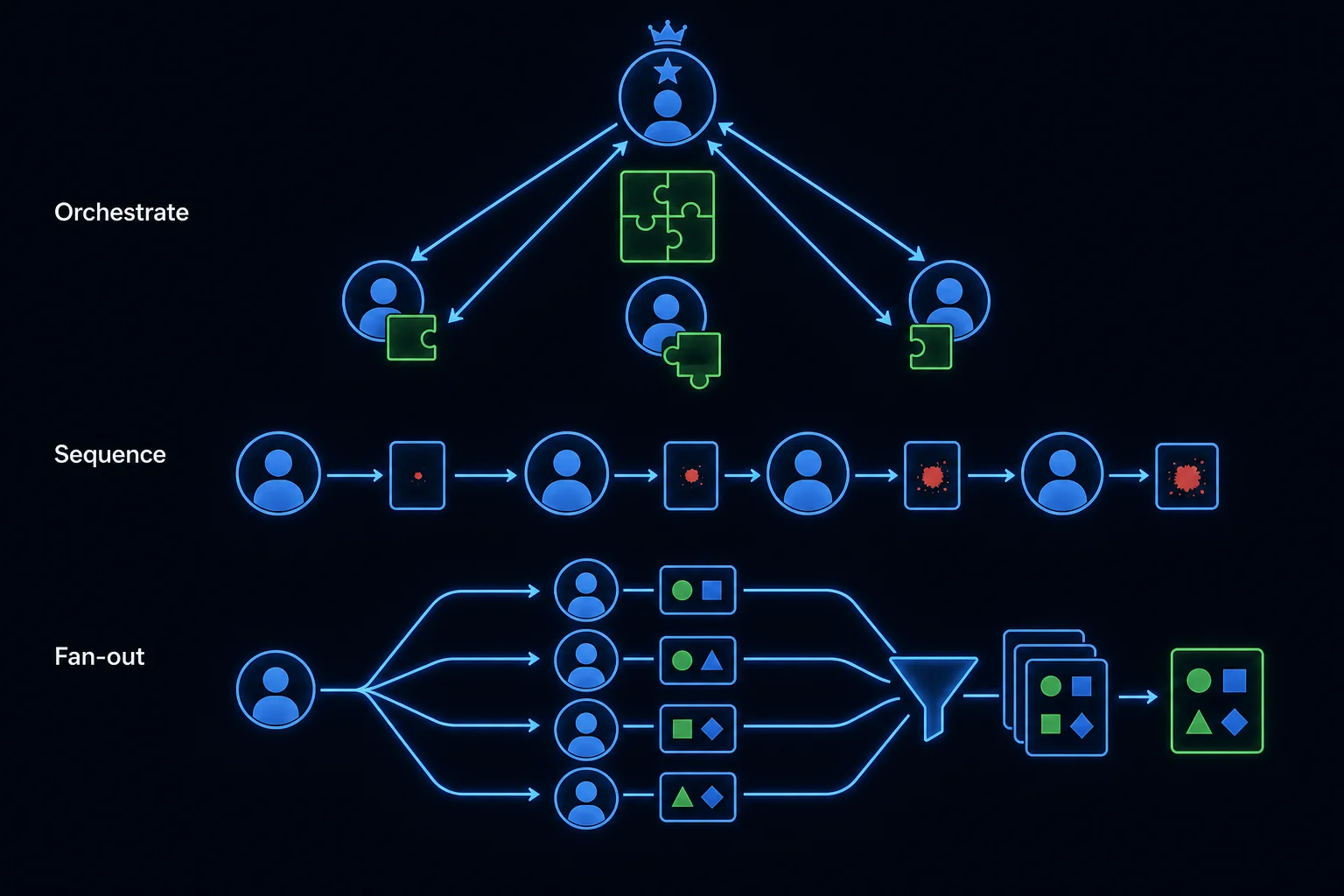
Orchestrator and workers
The most common pattern uses one orchestrator agent that owns the goal and delegates pieces to worker agents. The orchestrator reads the request, decides how to split it, hands each worker a focused sub-task, and assembles the workers' outputs into a final answer. Workers don't know about each other — they only know their slice — which keeps each prompt simple and each failure contained. This maps cleanly onto enterprise work: a planning agent breaks a ticket into steps, specialized agents execute them, and the orchestrator decides when the goal is met. The risk is that the orchestrator becomes a bottleneck and a single point of failure, so keep its logic auditable.
Sequential pipeline
When each stage depends on the previous one's output, use a sequential pipeline: agent A's result feeds agent B, whose result feeds agent C. Extract → enrich → validate → format is a typical chain. Pipelines are easy to reason about and easy to test stage by stage, but they have two hazards:
- Errors compound. A mistake early in the chain is inherited and amplified by every later stage.
- Latency adds up. Stages run one after another, so the total time is the sum of all of them.
Pipelines are the right choice only when the dependency between steps is real. If the stages are actually independent, you want fan-out instead.
Fan-out, then gather and synthesize
For independent sub-tasks, fan out the work to many workers running concurrently, then gather their outputs and synthesize a single result. Summarizing a hundred documents, checking a claim against several sources, or generating design variants all fit this shape. The synthesis step matters as much as the fan-out: a final agent has to reconcile, dedupe, and resolve conflicts between worker outputs, not just concatenate them. Done well, fan-out gives the biggest wall-clock win of any pattern because the slow part runs in parallel.
Mixing patterns
Real systems combine these. An orchestrator might fan out a research phase, run a sequential draft-then-review pipeline, and gather the results — patterns nest. The discipline is to keep each layer the simplest pattern that works, because every added agent and every added hop multiplies the ways the system can fail. The next lesson covers a pattern specifically for catching those failures: agents that verify each other.