Why Multiple Agents
Sometimes one model call isn't the right shape for the problem. A multi-agent system uses several model invocations — often with different roles, tools, or prompts — coordinated toward a single goal. The point isn't novelty; it's that some tasks genuinely don't fit inside one call. This lesson covers the three honest reasons to reach for more than one agent.
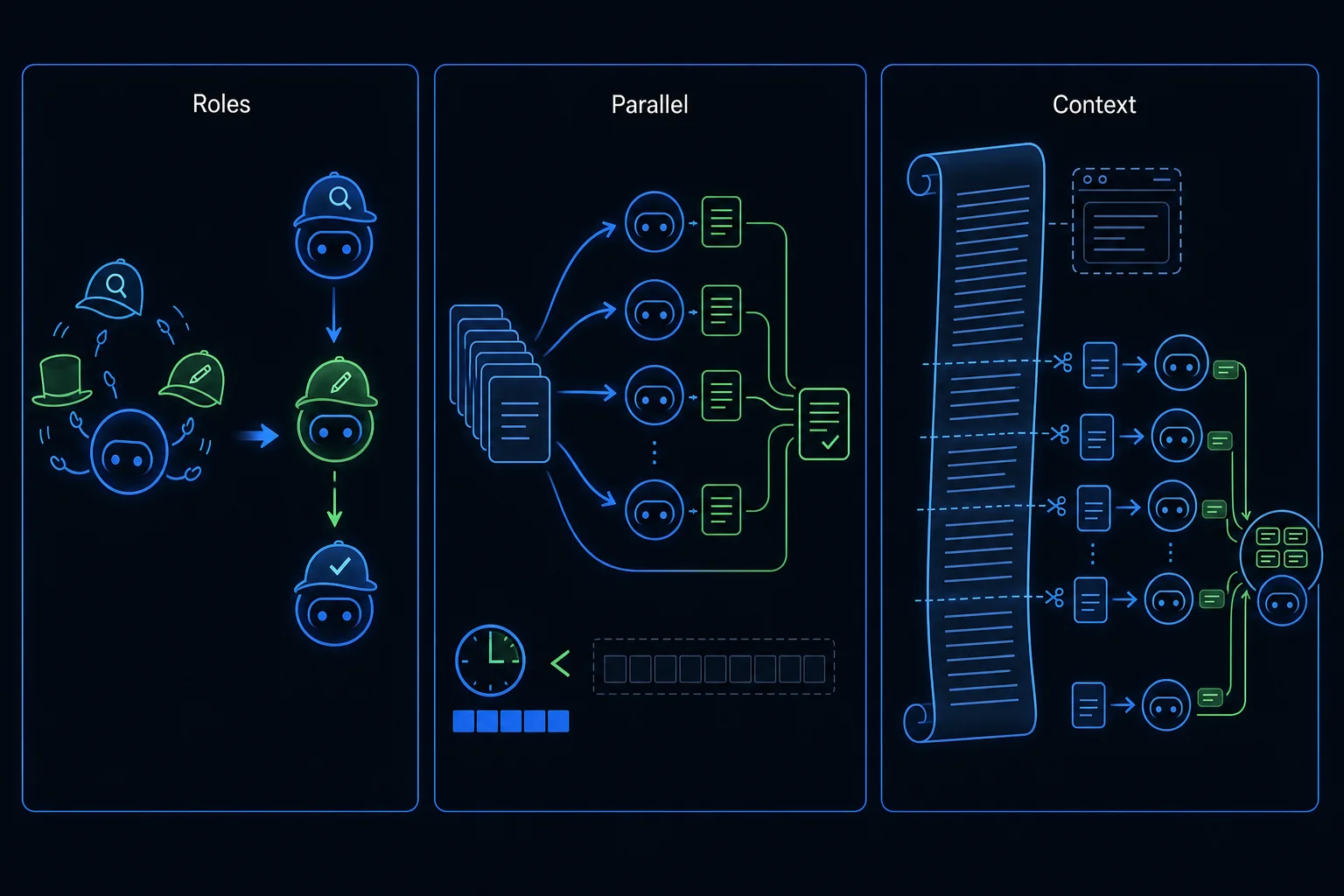
Decompose a big task into specialized roles
A single prompt that has to "research, draft, fact-check, and format" is doing four jobs at once, and the model splits its attention across all of them. Breaking the work into specialized agents — a researcher, a writer, a reviewer — lets each one carry a focused instruction set and a narrower definition of "done." Specialization tends to raise quality the same way it does on a human team: a reviewer told only to find problems is more critical than a writer asked to also check its own work. Each agent's prompt stays short, legible, and testable.
Parallelize independent work
When a task has independent sub-tasks, running them sequentially in one call wastes wall-clock time. Summarizing forty documents, checking a claim against five sources, or generating variants of a design are all fan-out workloads: the pieces don't depend on each other, so separate agents can run them concurrently and a final step gathers the results. This is the most defensible reason to go multi-agent — the speedup is real and the coordination is simple, because the workers never have to talk to each other.
Get around one context window's limits
Every model has a finite context window. A task that requires reading more material than fits — a large codebase, a long discovery set, a quarter of support tickets — cannot be done in one call no matter how good the prompt is. Multiple agents each take a slice of the input, work within their own window, and report compact findings up to a coordinator that never has to hold the raw material all at once. The agents act as a map step that shrinks a huge input into something a final call can reason over.
The honest caveat
These are the good reasons. None of them is "multi-agent sounds sophisticated." If your task fits in one window, has no independent parallelism, and doesn't need distinct roles, one well-prompted call will usually beat a committee — and it's cheaper and easier to debug. Reach for multiple agents when the task's shape demands it, not by default. The next lessons cover how to coordinate them, how to make them check each other, and how to keep the cost honest.