Starting an AI Program
Most AI programs fail not because the technology doesn't work, but because the organization points it at the wrong first problem. The instinct is to announce a moonshot — "AI will transform everything" — and then spend a year building a platform nobody asked for. The architect's job is to steer toward the opposite: a small, contained, high-value first win that earns the trust and budget for everything that follows.
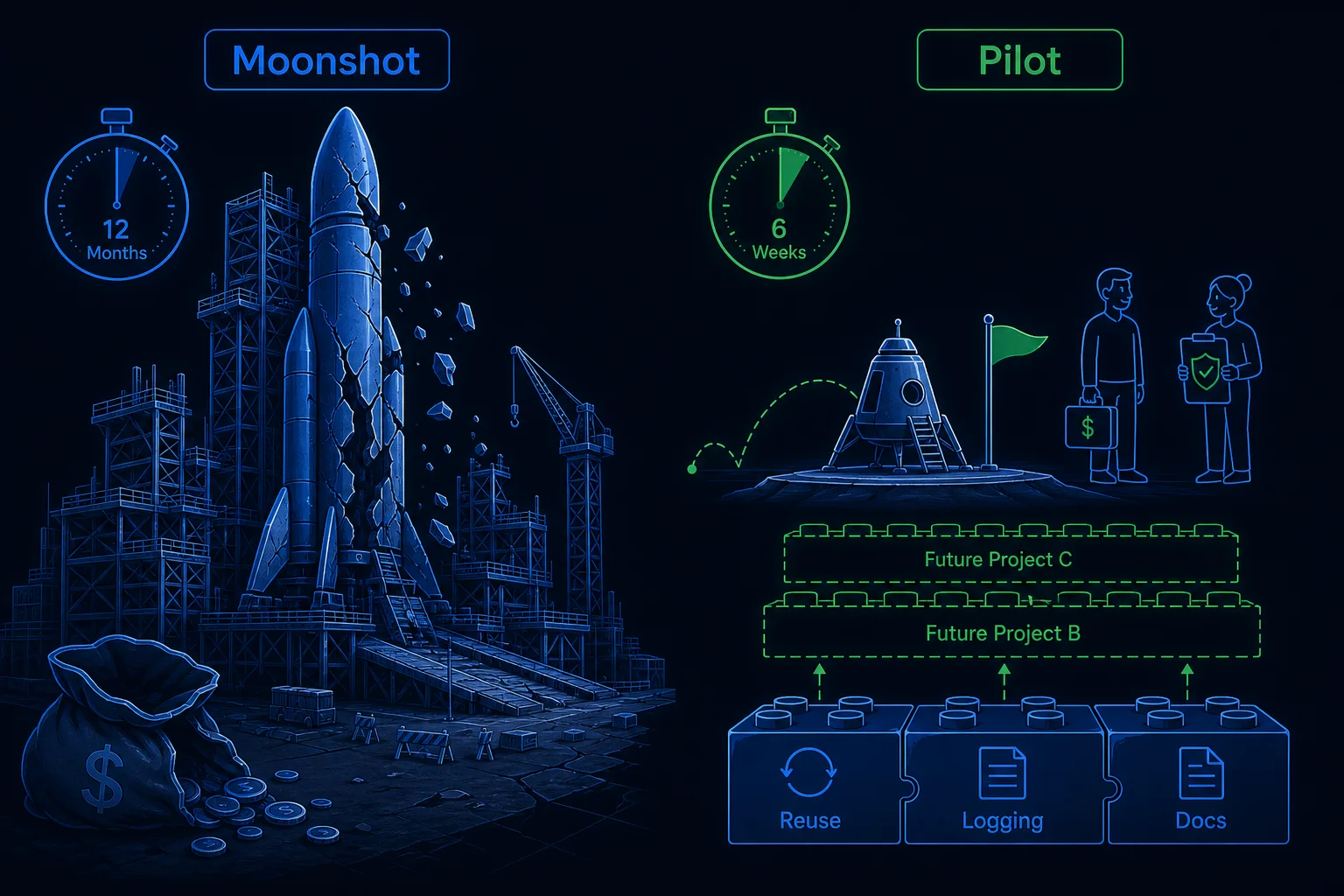
Start with a pilot, not a moonshot
A good first project is narrow, owned, and measurable. Pick one workflow where a real team feels real pain, where the data is already accessible, and where success is obvious within weeks. A pilot like this de-risks the program in three ways:
- It bounds the cost. A contained scope means a small bill and a short timeline, so a failure is cheap and a success is fast.
- It produces a reference. A working internal example is worth more than any vendor demo — it proves the pattern on your own data, in your own environment.
- It builds credibility. Skeptical stakeholders believe a tool their colleagues already use, not a slide deck.
Resist the urge to solve everything at once. The moonshot can come later, funded by the pilot's results.
Invest in reusable platform pieces
The difference between a pilot and a one-off demo is whether anything survives it. A demo is thrown away; a pilot leaves reusable assets behind. As you build the first use case, deliberately separate the parts that are specific to it from the parts every future use case will need:
- A shared RAG core — retrieval, chunking, embedding, and grounding logic — that the next project consumes instead of reinventing.
- AI-ready repositories: codebases with clear structure, documentation, and metadata that both engineers and AI tools can navigate.
- Common plumbing for routing, logging, and evaluation that makes the second use case cheaper than the first.
This is the 80/20 discipline: spend most of the effort on infrastructure that compounds, and keep the per-use-case work thin.
Secure sponsorship and a governance owner early
Technology is rarely the blocker — organizational alignment is. Two roles must exist before the first line of code:
- An executive sponsor who owns the budget, clears obstacles, and publicly backs the program. Without one, the pilot stalls the moment it touches another team's turf.
- A governance owner accountable for data handling, model approval, and acceptable use. In a public-sector or regulated setting, naming this person early is not bureaucracy — it is what makes the program deployable at all.
A program that starts with a contained pilot, reusable infrastructure, and named ownership is already most of the way to lasting adoption.