Identifying High-Value Use Cases
The fastest way to waste an AI budget is to chase impressive-sounding use cases that play to the technology's weaknesses. A high-value use case sits at a specific intersection: where AI's genuine strengths meet a real, measurable pain in your organization. Finding that intersection is a screening exercise, and the architect should run it before any code is written.
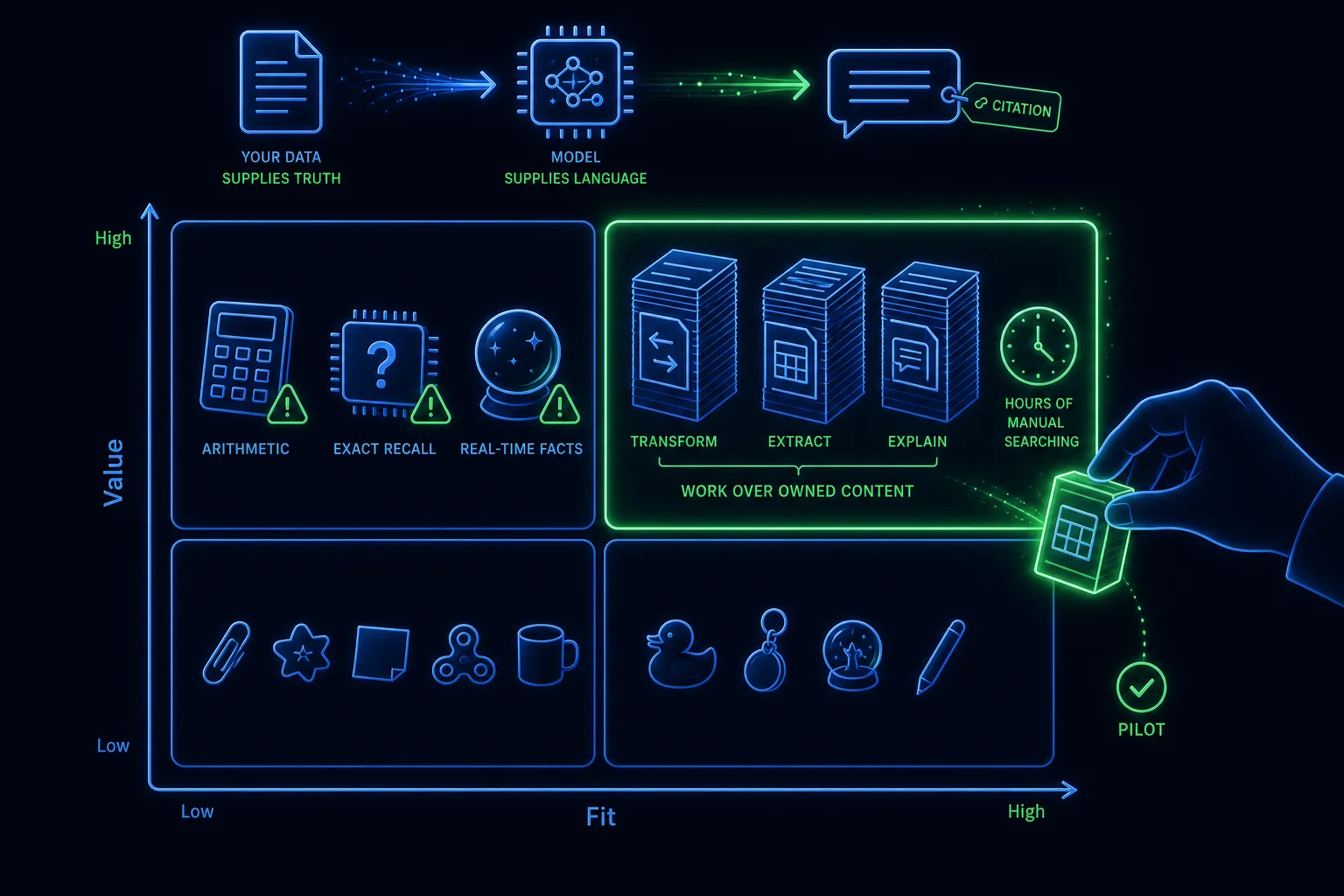
Match the work to AI's real strengths
Large language models are extraordinary at a narrow band of tasks: transforming, extracting, and explaining natural-language content. They shine when the job is to operate over text you already own — your policies, your manuals, your case files, your codebase.
- Transforming: rewriting, summarizing, translating, or reformatting existing content.
- Extracting: pulling structured facts, entities, or answers out of unstructured documents.
- Explaining: answering questions about your own material and citing where the answer came from.
Notice the common thread: AI working over your own content. This is exactly what a retrieval-augmented (RAG) system enables, and why a shared RAG library makes so many use cases viable at once. The model supplies the language skill; your data supplies the truth.
Avoid betting on capabilities it lacks
Just as important is knowing what not to ask for. A use case that depends on the model's weak spots will disappoint no matter how much you spend:
- Exact recall. A model does not reliably remember specific figures, dates, or policy clauses from training. Anything requiring precision must come from retrieval, not memory.
- Arithmetic and calculation. Numbers are not its strength; route math to code or a database.
- Real-time or authoritative facts. Without grounding, confident-sounding answers may simply be wrong.
A trustworthy pattern turns these weaknesses into strengths: retrieve the authoritative source, let the model explain it, and cite the source so a human can verify.
Score candidates by pain and fit
With strengths and weaknesses in mind, rank candidate use cases on two axes:
- Value — how much genuine time or cost does this remove? A workflow where staff spend hours hunting through documents is a strong candidate; a minor convenience is not.
- Fit — does the task live in AI's strength zone, with accessible, well-structured data?
The best first projects score high on both: a painful, document-heavy task that AI is naturally good at. In a public-sector context, also weigh sensitivity — a high-value case over public, non-personal data is far easier to ship than one touching protected records.
Use cases chosen this way tend to succeed quietly and repeatedly, which is exactly the momentum an adoption program needs.