Human-in-the-Loop and Accountability
AI governance ultimately reduces to one question a reviewer will always ask: "who is accountable for this AI decision?" The answer cannot be "the model." Human-in-the-loop design is how you keep a named person in the chain of responsibility — by inserting deliberate points where a human approves, reviews, or can override what the AI produces before it has real-world effect.
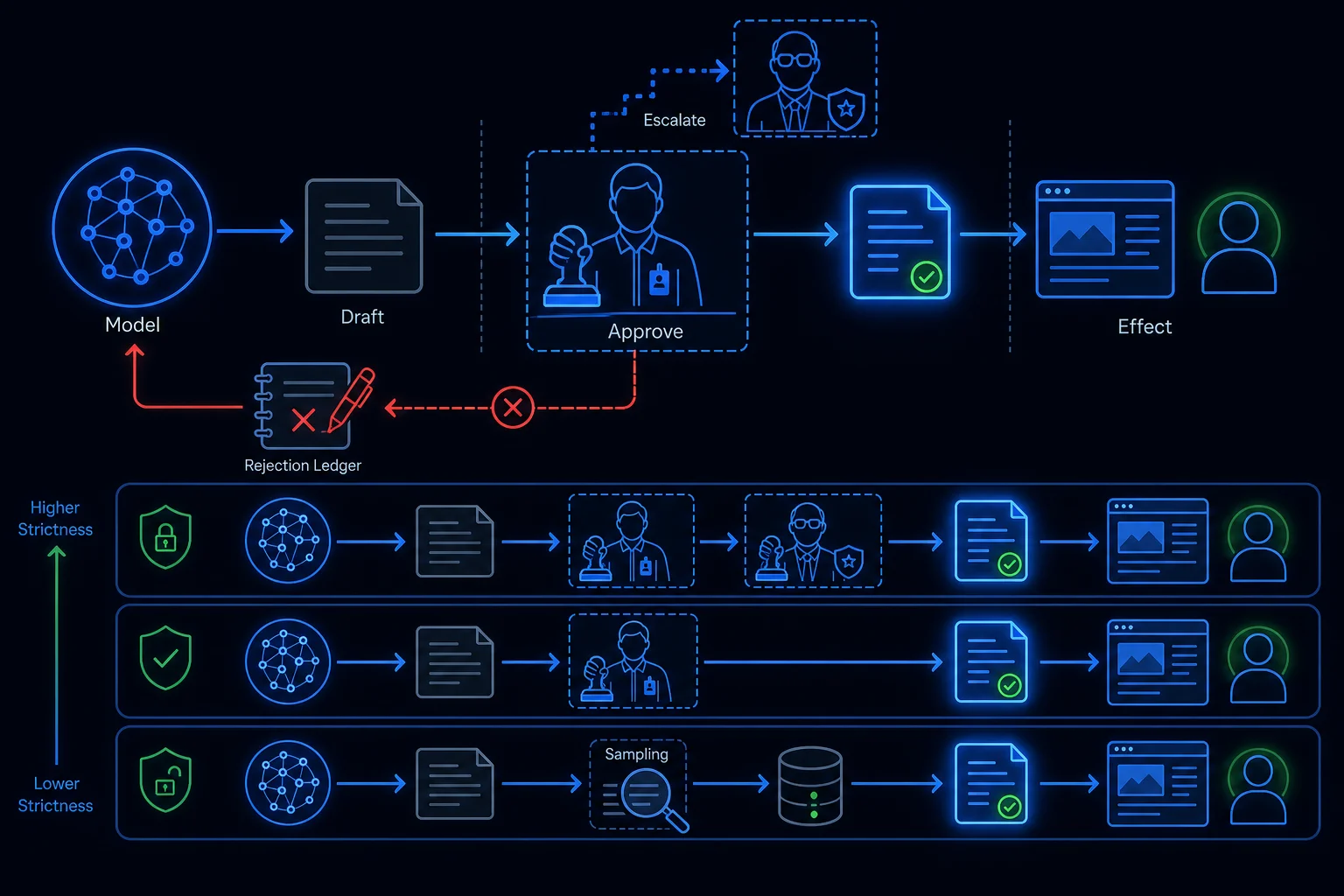
Approval gates before effect
The core pattern is to separate generating an AI output from acting on it. The model may produce a draft, a recommendation, or a score, but that artifact stays inert until a human (or a governed rule) approves it. Calibrate the gate to the risk of the decision:
- Low risk, reversible (a Tutor answer a learner can ignore) — log it, sample for review, no blocking gate.
- Medium risk (publishing AI-generated lesson content) — require human approval before it reaches users.
- High risk, rights-affecting (a benefits eligibility decision) — mandatory human review of every output, with the human, not the model, making the final call.
The architectural rule from earlier modules carries through: AI output is data, not an action until a human or an explicit policy promotes it.
Escalation paths
Human-in-the-loop is not just an approve button; it needs a clear path for what happens when something is wrong. A good design includes:
- A way for a reviewer to reject an output and have that rejection recorded and fed back.
- An escalation route when an output is uncertain, anomalous, or out of policy — to a senior reviewer or domain expert rather than a silent default.
- A fail-closed default: on low confidence or system error, hold the output for review rather than letting it through.
Making accountability concrete
Accountability is only real if it is recorded. Every consequential AI action should leave an append-only audit trail naming the model and version, the inputs, the output, the human who approved or rejected it, and when. That record is what lets you answer the accountability question with evidence — and what an auditor will ask to see.
How LyraLearn applies this
In LyraLearn, AI-generated content cannot reach a learner until it passes a human approval gate; the approver's identity and decision are written to the append-only audit log beside the model version and the per-call evaluation record. Low-stakes Tutor answers flow without a blocking gate but are still logged and sampled. The effect is that for any output the platform acts on, there is always a named human in the loop and a durable record of their decision — which is exactly what the compliance mapping in the next lesson depends on.