Model Registries and Versioning
If you cannot say which exact model and version produced a given output, you cannot audit it, reproduce it, or safely upgrade it. A model registry is the system of record that answers that question. It is the single most under-built piece of "enterprise AI," and the first thing a serious reviewer asks for.
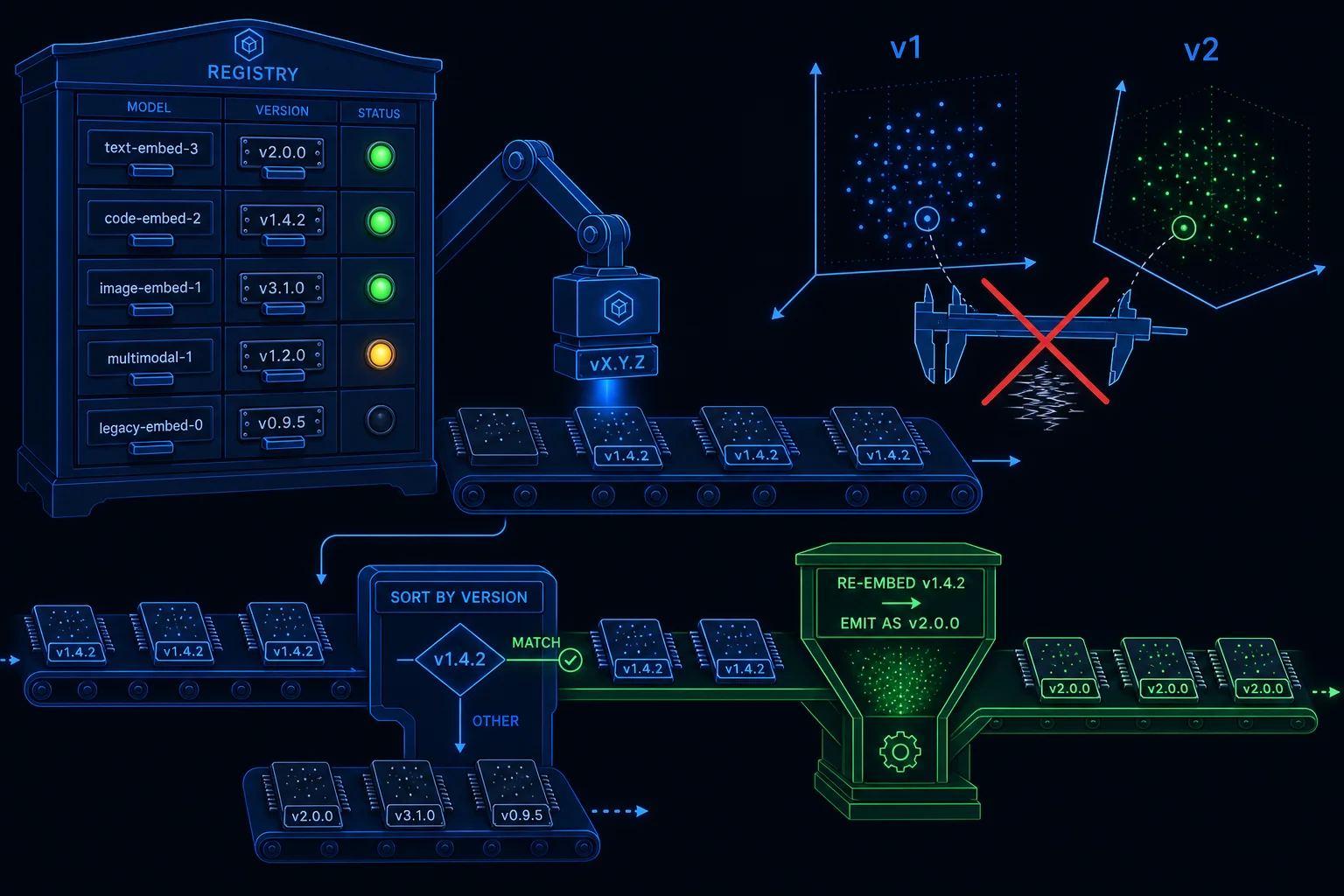
What a registry tracks
A registry is more than a folder of weights. For every model in use it records:
- Identity and version — a stable name plus an immutable version string (e.g.
text-embedding-3-large@v2). Versions are append-only; you never silently mutate one in place. - Provenance — where the model came from, when it was registered, who approved it, and what it's approved for.
- Configuration — the parameters that change behavior: dimensions, temperature, the prompt template, the chunking strategy. Two outputs from "the same model" with different configs are not comparable.
- Lifecycle state —
active,deprecated, orretired, so callers always resolve to a governed, approved version rather than whatever happens to be installed.
In .NET this maps naturally to a small registry service backed by a SQL Server table, injected wherever a model is called, so no code path can invoke a model that isn't registered.
Why versioning is non-negotiable
Embeddings make the danger vivid. A vector produced by model v1 is not comparable to a vector from v2 — the coordinate spaces differ, so cosine similarity between them is noise. If you upgrade the embedding model without re-embedding the corpus, retrieval silently degrades and no error is thrown. The registry prevents this: because every stored vector carries its embedding-model version, the system knows exactly which records predate an upgrade and must be re-embedded, and it can refuse to compare across versions.
Versioning also makes provenance auditable. When an output is questioned months later, the registry plus the audit log let you reconstruct the precise model, version, and config that produced it — the difference between "we think it was the old model" and a defensible record.
How LyraLearn implements it
LyraLearn records the active embedding-model version alongside every vector it stores. When the active version changes, the platform can identify and re-embed stale content rather than mixing incompatible vectors, and every Tutor answer is logged against the model version that generated it. That single discipline — version stamped on every artifact — is what turns "we run AI" into "we can prove what our AI did," and it is the foundation the human-oversight and compliance controls in the next lessons build on.