Speech and Translation
Speech is the modality this platform uses in production every day: the narration button on this lesson is a TTS model doing real work. Speech services split into two directions — speech-to-text (STT) and text-to-speech (TTS) — and both are exam staples with distinct architectural patterns.
Speech-to-text: transcription at scale
STT converts audio into text, and on Azure it lives in the Azure AI Speech service. The classic enterprise workloads:
- Call centers — transcribe every call, then run sentiment analysis, compliance checks, or summarization over the transcripts. Real-time transcription can even feed live agent-assist.
- Meeting notes — batch-transcribe recordings, with speaker diarization (who said what) turning a wall of text into attributable minutes.
- Voice interfaces — the front door of any voice bot is an STT call before the LLM ever sees a token.
Architecturally, know the difference between real-time transcription (streaming, low latency, per-second pricing) and batch transcription (async jobs over stored audio, cheaper, ideal for archives). Custom speech models can be trained on domain vocabulary — drug names, statute citations, product SKUs — where the base model's error rate hurts.
Text-to-speech: this platform is the demo
TTS synthesizes natural speech from text. LyraLearn generates the narration for every lesson
you can play right now via a hosted TTS model (OpenAI's gpt-4o-mini-tts) — a genuine production
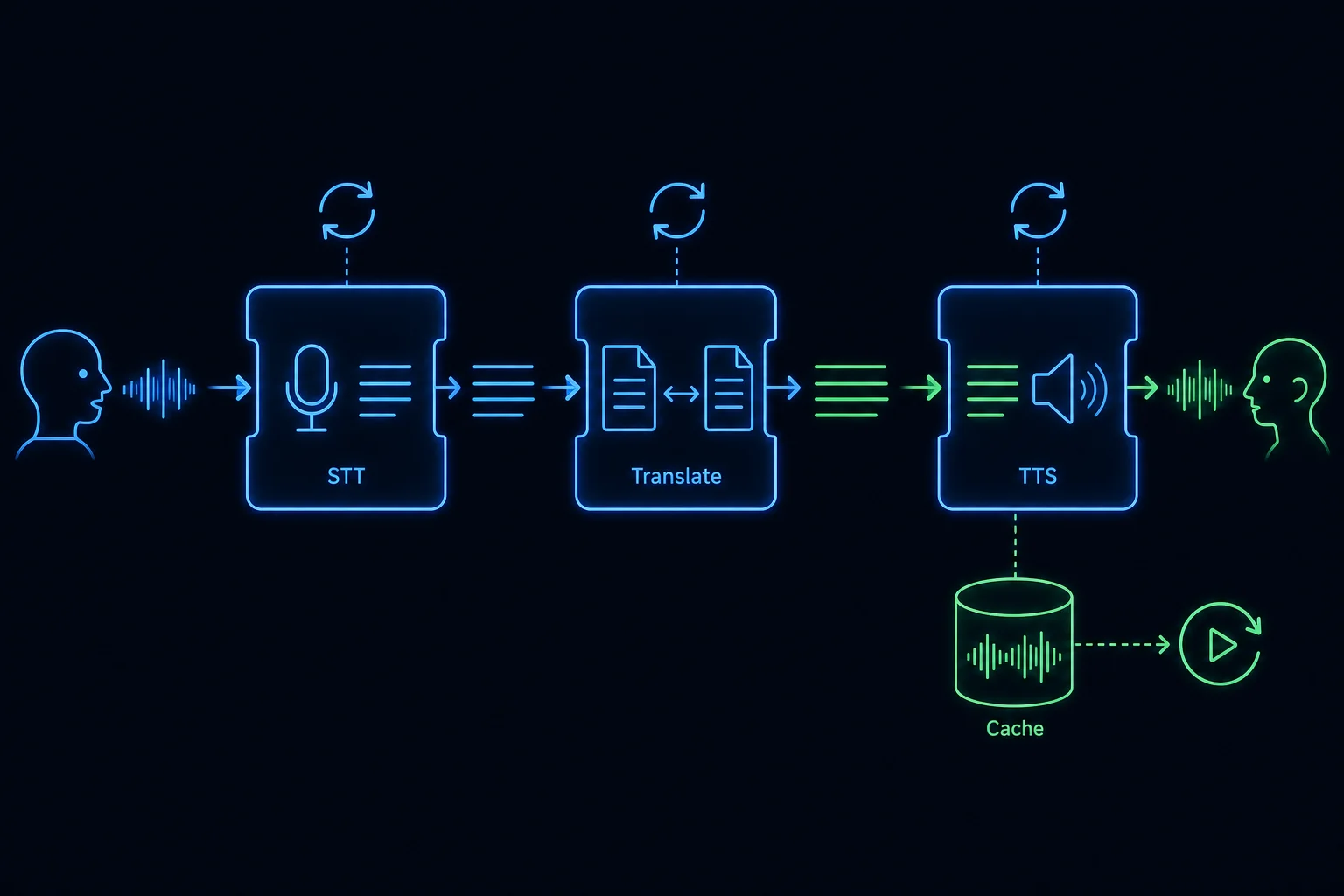
speech pipeline, not a slide-deck example. The pipeline pattern generalizes: generate audio once
per content revision, cache the file, serve it statically. Synthesis is the expensive step; never
re-synthesize unchanged text.
Two controls matter in practice. Voice selection — services offer catalogs of neural voices varying by language, gender, and style; picking one is a product decision (a citizen services line and a children's reading app need different voices). And pacing control — Azure AI Speech accepts SSML (Speech Synthesis Markup Language) to control rate, pauses, pronunciation, and emphasis; newer model-based TTS (like this platform's) takes natural-language style instructions instead. Either way, the architect's job is to expose pacing and voice as configuration, not hardcode them.
Translation and multilingual service delivery
Azure AI Translator provides text translation across 100+ languages; Azure AI Speech adds speech translation (speech in one language, text or speech out in another). For public-sector work this is frequently a legal accessibility requirement, not a nice-to-have: agencies must serve residents in the languages their communities actually speak, and human translation of every form, notice, and chatbot reply doesn't scale.
The composable pattern to remember for the exam: STT → translate → TTS chains three managed services into a real-time multilingual pipeline — a caller speaks Spanish, a caseworker reads English, and the reply returns as synthesized Spanish. Each stage is independently swappable, which is exactly why the services are designed as separate building blocks.