Why AI Governance
Once an AI feature influences a real decision — who gets a service, which document is flagged, what answer a citizen receives — someone will eventually ask "why did the system do that, and who is responsible?" AI governance is the set of policies, controls, and records that let you answer those questions with evidence rather than hand-waving. For an enterprise or public-sector architect, it is not paperwork bolted on at the end; it is a design input from day one.
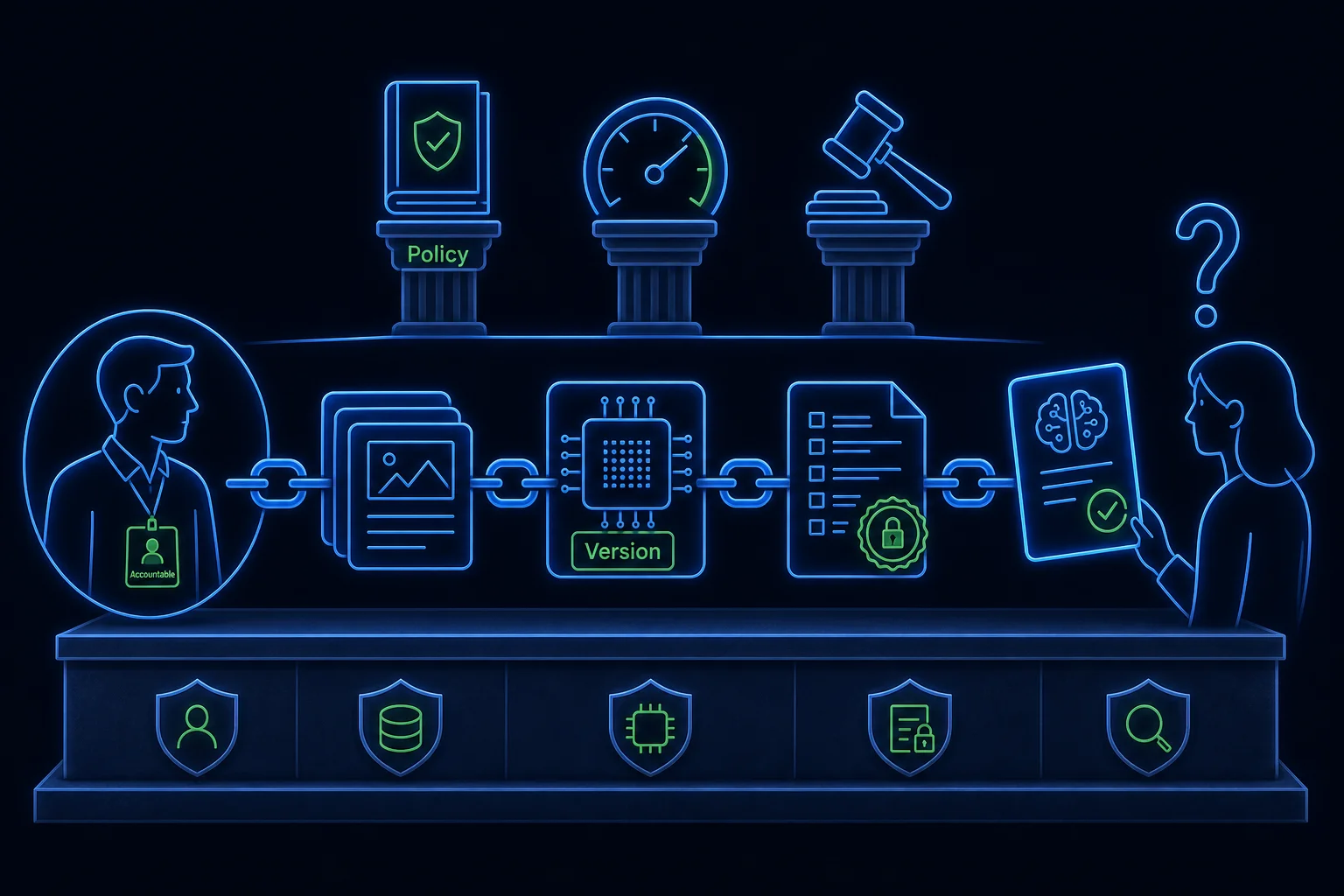
Policy, risk, and accountability
Governance turns vague intent into enforceable rules. Three pillars carry most of the weight:
- Policy — written rules for what AI may and may not do: approved use cases, prohibited uses, data that may be sent to a model, required human review. Policy is what an auditor reads first.
- Risk management — a deliberate process for identifying, rating, and mitigating AI-specific harms: biased outputs, hallucinated facts, data leakage, model drift. Each risk gets an owner and a control, not just a mention.
- Accountability — a named human or role answerable for each AI decision. "The model decided" is never an acceptable answer in a regulated setting.
The architect's job is to make these pillars concrete in the system — as gates, logs, and configuration — so compliance is a property of the running software, not a promise in a document.
Public trust as a hard requirement
In a government or public-sector context the stakes are higher because AI decisions must be defensible. A citizen denied a benefit, or flagged by an automated screen, has a legitimate right to an explanation and a path to appeal. If the system cannot reconstruct which model, which version, and which inputs produced an output, the decision is indefensible — and the program loses public trust, which is far harder to rebuild than to keep.
This is why governance emphasizes transparency and traceability: not because regulators enjoy forms, but because a decision you cannot explain is a decision you cannot stand behind.
How LyraLearn embodies it
LyraLearn treats itself as a worked example. Every AI action — generating lesson content, embedding a passage, answering a Tutor question — is recorded against a specific model version in an append-only audit log, with a per-call evaluation record capturing inputs, outputs, and a quality score. Generated content passes a human approval gate before it can affect a learner. The result: for any AI output the platform has ever produced, you can name the model, the version, the moment, and the human accountable. That capability is governance — the rest of this module shows how each mechanism is built.